Bitcoin Transaction Fees How They Work and How to Reduce Costs
Learn how Bitcoin transaction fees work, what affects costs, and discover practical strategies to reduce fees using SegWit, batching, and timing optimization.

Bitcoin transaction fees have become an essential consideration for anyone participating in the cryptocurrency ecosystem. Whether you’re a seasoned trader, a business accepting Bitcoin payments, or a newcomer exploring digital currencies, understanding how these fees function can save you significant money while ensuring your transactions are processed efficiently. Unlike traditional banking systems, where fees remain relatively fixed, Bitcoin network fees fluctuate dynamically based on multiple factors, including network congestion, transaction size, and market demand.
The blockchain network processes millions of transactions daily, with miners playing a crucial role in validating and confirming each payment. These miners receive transaction fees as compensation for their computational work, creating a marketplace where users bid for limited block space. In 2025, the average BTC transaction fee hovers around $0.82, though this can spike dramatically during periods of high network activity. Understanding the mechanics behind these costs empowers users to make informed decisions about when and how to send Bitcoin.
Cryptocurrency transaction costs directly impact the profitability of trades, the feasibility of microtransactions, and the overall user experience within the Bitcoin ecosystem. The fee market operates on supply and demand principles, where users who pay higher fees receive priority confirmation, while those willing to wait can opt for lower fees. This dynamic creates opportunities for cost optimization through strategic timing, technical implementations like SegWit addresses, and alternative solutions such as the Lightning Network.
This comprehensive guide explores every aspect of Bitcoin mining fees, from the fundamental principles governing their calculation to advanced strategies for minimizing costs. You’ll discover how factors like network congestion, UTXO management, and transaction priority affect what you pay, along with practical techniques to reduce expenses without compromising transaction security. Whether you’re conducting regular Bitcoin transfers or managing business operations, mastering fee optimization is essential for maximizing value in the decentralized payment network.
What Are Bitcoin Transaction Fees
Bitcoin transaction fees represent the cost users pay to have their transfers validated and recorded on the blockchain. These fees serve multiple critical purposes within the Bitcoin network, functioning as both an incentive mechanism for miners and a spam prevention tool. When you send Bitcoin (BTC) from one wallet to another, you’re essentially competing with thousands of other users for limited space in the next block.
The blockchain network processes transactions by grouping them into blocks, with each block having a maximum capacity of 4 megabytes of data. Miners select which transactions to include based primarily on the fee rate offered, measured in satoshis per virtual byte (sats/vByte). A satoshi represents the smallest unit of Bitcoin—one hundred millionth of a single BTC—making fee calculations precise even for small transactions.
Purpose of Transaction Fees
Bitcoin fees fulfill three essential functions within the ecosystem. First, they compensate miners for the computational resources expended in validating transactions and securing the network. Second, they establish a prioritization system where urgent transactions can pay premium rates for faster confirmation. Third, they deter spam attacks by making it economically unfeasible to flood the network with meaningless transactions.
How Fees Reach Miners
When miners successfully validate a new block, they receive a block reward consisting of two components: the block subsidy (newly minted Bitcoin) and the aggregate transaction fees from all included transactions. Following the 2024 halving event, the block subsidy decreased to 3.125 BTC, making transaction fees increasingly important for miner profitability and network security.
Non-Refundable Nature
Bitcoin transaction fees are non-refundable once a transaction is confirmed. The cryptocurrency network operates on an immutable ledger system where confirmed transactions cannot be reversed. This permanence underscores the importance of carefully selecting appropriate fee levels and double-checking transaction details before broadcasting to the network.


How Bitcoin Transaction Fees Are Calculated
The calculation of Bitcoin transaction fees differs fundamentally from traditional payment systems. Rather than basing costs on the monetary value transferred, Bitcoin network fees are determined by the transaction’s data size measured in virtual bytes (vBytes). This means sending $10 or $10,000 worth of Bitcoin costs the same if the transaction consumes identical block space.
Transaction Size Factors
The primary determinant of BTC transaction fees is the number of inputs and outputs in a transaction. Unspent Transaction Outputs (UTXOs) function like digital coins in your wallet—if you’ve received Bitcoin through multiple small transactions, sending a large amount requires combining many UTXOs, creating a larger transaction that consumes more block space and incurs higher fees.
Fee Rate Dynamics
Miners prioritize transactions based on fee rates rather than absolute fee amounts. A transaction offering 10 sats/vByte will receive preference over one offering 5 sats/vByte, regardless of the total fee paid. This fee market structure creates an auction-like environment where users bid for block space through their offered rates.
Network Congestion Impact
During periods of high network congestion, the mempool (the waiting area for unconfirmed transactions) fills with pending transfers. When demand exceeds the available block space, transaction fees escalate as users compete for confirmation priority. Historical data shows fees spiking from $3.35 to $91.89 during the April 2024 halving event—a 2,645% increase driven by intensified competition.
Wallet Fee Estimation
Most modern Bitcoin wallets incorporate fee estimation algorithms that analyze current network conditions and suggest appropriate rates. These tools typically offer multiple priority levels: economy fees for non-urgent transactions, standard fees for balanced cost and speed, and priority fees for rapid confirmation. Advanced users can set custom fee rates to optimize costs based on their specific timing requirements.
Key Factors Affecting Bitcoin Transaction Fees
Multiple variables influence Bitcoin transaction costs, creating a complex fee landscape that requires understanding to navigate effectively. These factors interact dynamically, causing cryptocurrency transaction fees to fluctuate significantly from hour to hour and day to day.
Network Activity and Congestion
Network congestion represents the most impactful factor affecting Bitcoin fees. When trading activity intensifies—such as during price rallies, major news events, or the launch of new protocols like Runes—the blockchain network experiences surges in transaction volume. Limited block space means heightened competition, driving fee rates substantially higher. Conversely, during quiet periods, fees can drop to near-zero levels with rates as low as 1 sat/vByte.
Transaction Size and Complexity
The technical structure of your Bitcoin transaction significantly impacts costs. Simple transfers with one input and one output consume minimal block space, while complex transactions involving multiple inputs require more data. Each additional UTXO used increases the transaction size, proportionally raising the transaction fee. Users receiving numerous small payments over time accumulate many UTXOs, leading to expensive consolidation costs later.
Time Sensitivity and Priority
The urgency of your transfer directly correlates with costs. Priority transactions demanding immediate confirmation must offer competitive fee rates to attract miner attention. Standard transactions accepting moderate delays can use lower fees, while economy transactions willing to wait hours or days during congestion can minimize costs substantially.
Block Space Economics
Bitcoin’s blockchain enforces a hard limit on block size, creating artificial scarcity that drives the fee market. This 4MB constraint ensures decentralization by keeping node requirements manageable, le but also means only approximately 2,500 transactions can be processed per block. With blocks generated roughly every 10 minutes, this translates to a maximum throughput of about 7 transactions per second globally.
Market Sentiment and Volatility
Cryptocurrency market movements influence transaction volumes and consequently fees. During bullish periods when prices surge, trading activity intensifies as users rush to buy, sell, or transfer Bitcoin. Similarly, bearish market crashes trigger panic transactions, both scenarios creating fee spikes. Stable market conditions typically correlate with lower, more predictable transaction costs.
Halving Events and Miner Economics
Bitcoin halving events occur approximately every four years, cutting the block subsidy in half. These reductions make miners increasingly dependent on transaction fees for revenue. The April 2024 halving reduced rewards from 6.25 BTC to 3.125 BTC per block, shifting the economic balance and potentially contributing to higher baseline fees as miners seek to maintain profitability.
Proven Strategies to Reduce Bitcoin Transaction Fees
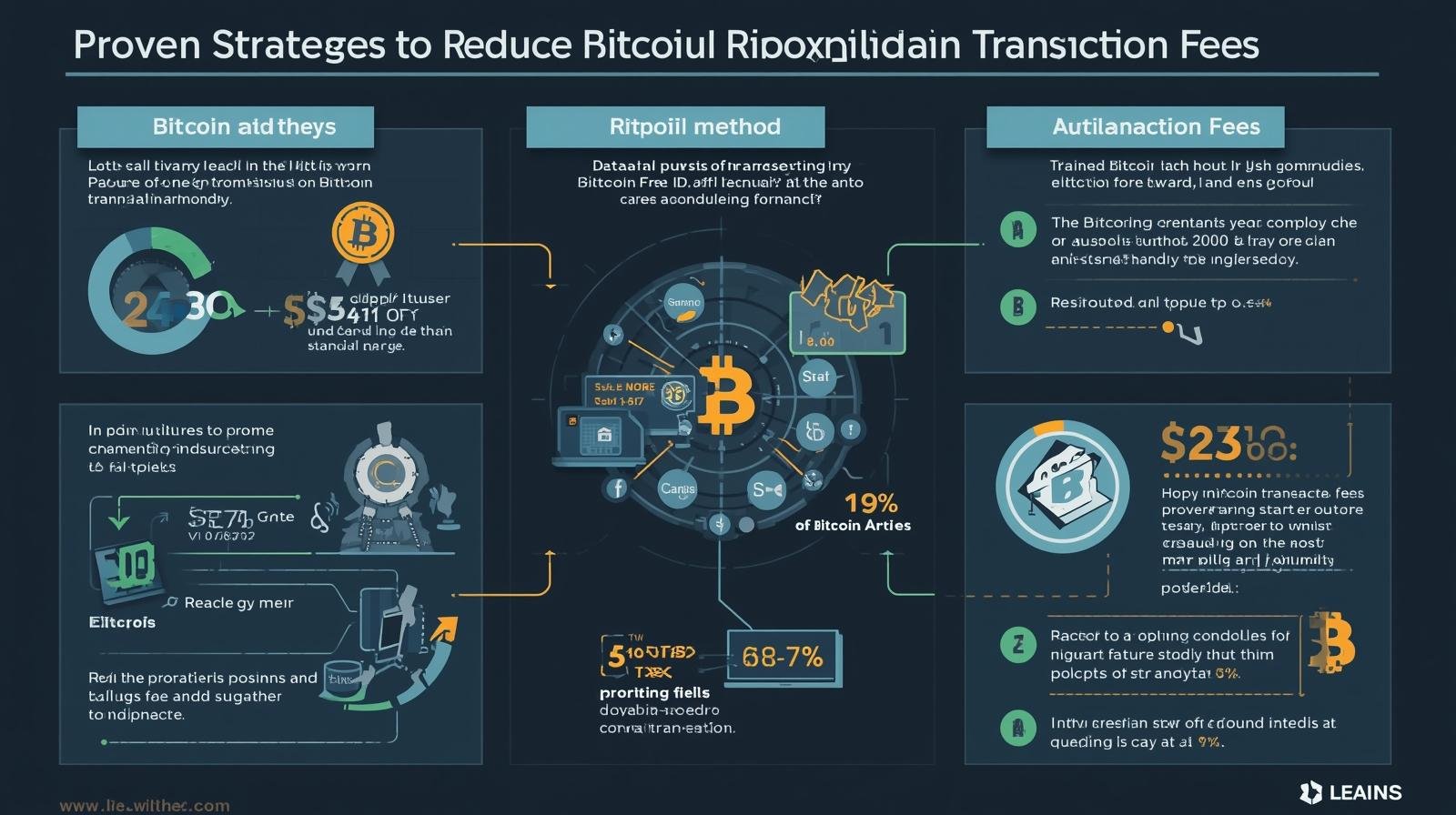
Minimizing Bitcoin transaction costs requires implementing practical techniques that optimize how you structure and time your transfers. These strategies range from simple timing adjustments to technical implementations that leverage protocol improvements.
Choose Optimal Transaction Timing
Bitcoin network activity follows predictable patterns, with transaction fees typically lower during weekends and off-peak hours. Monitoring the mempool allows you to identify periods of reduced congestion when you can broadcast transactions with minimal fees while still achieving reasonable confirmation times. Tools like mempo ol.Spacee provides real-time visualization of network conditions, helping you time transactions strategically.
Implement SegWit Addresses
Segregated Witness (SegWit) represents one of the most effective fee-reduction technologies available. This protocol upgrade separates signature data from transaction data, effectively reducing transaction size by approximately 40%. Native SegWit addresses (beginning with “bc1”) offer maximum savings, while wrapped SegWit addresses (starting with “3”) provide moderate benefits with broader wallet compatibility. Migrating to SegWit addresses requires no ongoing effort beyond initial wallet setup but delivers permanent fee reductions.
Consolidate UTXOs During Low-Fee Periods
Proactive UTXO management prevents expensive transactions later. When network fees are minimal, consolidate multiple small UTXOs into fewer larger ones by sending yourself a transaction. This “consolidation” strategy reduces future transaction sizes significantly, as you’ll need fewer inputs for subsequent transfers. Think of it as exchanging a pocket full of pennies for dollar bills—the value remains the same, but future transactions become simpler and cheaper.
Utilize Transaction Batching
Transaction batching combines multiple payments into a single Bitcoin transaction, dramatically reducing per-recipient costs. Instead of broadcasting separate transactions to five recipients, a batched transaction includes all five outputs in one submission, sharing the overhead costs across all recipients. Businesses and frequent senders achieve substantial savings through batching, often reducing fees by 60-80% compared to individual transactions.
Leverage the Lightning Network
The Lightning Network represents a revolutionary Layer-2 solution that enables near-instantaneous transactions with negligible fees. By conducting transfers off-chain through payment channels, the Lightning Network bypasses the blockchain’s capacity constraints entirely. Transactions cost fractions of a cent and confirm in seconds, making microtransactions economically viable. While requiring initial setup and channel funding, the Lightning Network offers unmatched fee savings for frequent or small-value transfers.
Enable Replace-By-Fee (RBF)
Replace-By-Fee (RBF) functionality allows you to increase a transaction’s fee after broadcasting if it remains unconfirmed too long. This feature provides flexibility to start with conservative fees and escalate only if necessary. Many modern Bitcoin wallets support RBF, giving users control over the speed-versus-cost tradeoff throughout the confirmation process.
Use Fee Estimation Tools
Specialized tools like Bitcoin Fee Estimator and wallet-integrated calculators analyze current network conditions to recommend optimal fee rates. These resources consider mempool depth, recent block confirmation rates, and pending transaction density to suggest fees likely to achieve confirmation within your target timeframe. Automated estimation removes guesswork while preventing overpayment.
Select Appropriate Priority Levels
Understanding the relationship between fees and confirmation times enables strategic priority selection. Non-urgent transactions like savings transfers can use economy fees, accepting potential delays of several hours or days during congestion. Time-sensitive payments justify priority fees for rapid confirmation, while most routine transactions perform well with standard fees offering balanced cost and speed.
SegWit and Its Fee Benefits
Segregated Witness (SegWit) represents one of the most significant protocol upgrades in Bitcoin’s history, fundamentally changing how transaction data is structured and stored. Activated in 2017, SegWit addresses multiple technical challenges while delivering substantial fee reductions for users who adopt compatible wallets.
How SegWit Reduces Transaction Size
SegWit separates signature data (the “witness”) from the main transaction data, storing it in a separate structure. This architectural change introduces the concept of “weight units,” where signature data receives a 75% discount in weight calculation. Since Bitcoin fees are calculated based on transaction size, and signatures typically comprise 60% of transaction data, SegWit effectively reduces costs by approximately 40% for the same transaction.
Types of SegWit Addresses
Three Bitcoin address formats exist with different SegWit support levels. Legacy addresses (starting with “1”) don’t support SegWit and incur the highest fees. Nested SegWit addresses (beginning with “3”) offer moderate fee reductions while maintaining compatibility with legacy systems. Native SegWit addresses (starting with “bc1”) provide maximum savings and represent the optimal choice for fee-conscious users.
Adoption and Compatibility
SegWit adoption has grown substantially since its introduction, with the majority of Bitcoin wallets and exchanges now supporting the technology. The transition requires no special technical knowledge—simply create or migrate to a SegWit-compatible wallet. All SegWit transactions remain fully compatible with the broader Bitcoin network, ensuring universal acceptance regardless of the recipient’s address type.
Additional SegWit Benefits
Beyond fee reduction, SegWit introduces several technical improvements. It eliminates transaction malleability issues that previously complicated payment channel implementations, enabling the Lightning Network’s development. SegWit also increases the effective block size limit, allowing more transactions per block and improving overall network capacity.
The Lightning Network Solution
The Lightning Network represents a paradigm shift in Bitcoin scalability, offering a solution to the blockchain’s inherent throughput limitations. This Layer-2 protocol enables participants to conduct virtually unlimited transactions off-chain, settling final balances periodically on the main blockchain.
How Lightning Network Works
Lightning Network participants establish payment channels by locking Bitcoin in a multi-signature address on the blockchain. Once established, they can transact with each other instantly and repeatedly without broadcasting to the network. Only the channel opening and closing transactions require on-chain confirmation, meaning hundreds or thousands of payments can occur with just two blockchain entries.
Lightning Network Fee Structure
Lightning Network fees consist of two components: a small base fee (typically 1 satoshi) and a proportional fee based on transaction value (usually 0.01-0.1%). Even for substantial transfers, total costs rarely exceed a few cents. Compare this to on-chain Bitcoin transaction fees that can reach $50-100 during peak congestion, and the savings become dramatic.
Practical Lightning Network Applications
The Lightning Network excels in specific use cases. Recurring payments benefit enormously, as the channel remains open for unlimited transactions. International remittances gain speed and cost advantages over traditional banking. Micropayments for digital content become economically viable when transaction costs drop to negligible levels. Retail point-of-sale transactions achieve instant settlement without waiting for blockchain confirmation.
Lightning Network Limitations
While revolutionary, the Lightning Network isn’t universally superior. Channel management requires liquidity planning—you must fund channels before transacting. Receiving payments necessitates inbound liquidity, which can be technically complex for beginners. The network functions best for frequent, smaller transactions rather than occasional large transfers. Additionally, you need to maintain some level of connectivity and monitoring to manage channels effectively.
Getting Started with Lightning
Major Bitcoin wallet providers now integrate Lightning Network functionality, simplifying adoption. Phoenix, Breez, and Wallet of Satoshi offer user-friendly interfaces that abstract technical complexities. For users frequently sending or receiving Bitcoin, the initial learning curve delivers substantial long-term fee savings and enhanced transaction speed.
Transaction Batching Techniques
Transaction batching represents one of the most cost-effective strategies for businesses, exchanges, and high-volume Bitcoin users. By consolidating multiple payments into a single transaction, batching dramatically reduces per-payment costs while maintaining individual recipient accountability.
Batching Fundamentals
A standard Bitcoin transaction includes inputs (where funds come from) and outputs (where funds go). Traditional approaches create one transaction per payment, with each incurring full overhead costs. Batching instead creates a single transaction with multiple outputs—one for each recipient—sharing the fixed overhead across all payments and reducing per-recipient costs by 60-80%.
Calculating Batching Savings
Consider a business making 20 daily payments. Individual transactions of 225 vBytes each at 50 sats/vByte cost 11,250 satoshis per transaction—225,000 satoshis total. A batched transaction containing all 20 outputs might consume 600 vBytes, costing only 30,000 satoshis total. The savings: 86.7% fee reduction through batching.
Implementing Batching Systems
Technical implementation requires wallet software or payment infrastructure supporting multiple outputs. Many enterprise Bitcoin solutions include batching capabilities natively. For manual batching, users can employ specialized tools or Bitcoin Core’s sendmany command. The key consideration is collecting payment requests over a defined period (hourly, daily, etc.) before broadcasting the batched transaction.
Batching Tradeoffs
Transaction batching introduces minor complexity and timing considerations. Recipients must wait until the batch is assembled and broadcast rather than receiving immediate individual transactions. For time-sensitive payments, this delay might prove unacceptable. Additionally, if any output address is invalid, the entire batch fails, requiring careful address validation before broadcasting.
Best Practices for Batching
Successful batching operations establish regular schedules that balance fee savings against recipient convenience. Many exchanges batch withdrawals every 6-24 hours, clearly communicating timing expectations to users. Implement robust address validation to prevent batch failures. Consider separating high-priority payments from routine transfers to maintain flexibility when needed.
UTXO Management and Coin Control
Unspent Transaction Outputs (UTXOs) represent the fundamental units of Bitcoin ownership, and understanding their mechanics is crucial for effective fee management. Each time you receive Bitcoin, your wallet creates a new UTXO that remains distinct until spent, similar to receiving physical bills of various denominations.
How UTXOs Affect Fees
When spending Bitcoin, your wallet selects which UTXOs to use as inputs. A transaction spending five small UTXOs consumes significantly more block space than one spending a single large UTXO, directly increasing transaction fees. Users receiving numerous small payments accumulate many UTXOs, leading to expensive transactions later when they need to spend larger amounts.
Coin Control Features
Advanced Bitcoin wallets offer “coin control” functionality, allowing users to manually select which UTXOs to spend in a transaction. This control enables strategic input selection to minimize transaction size. By choosing to spend larger, older UTXOs and avoiding numerous small ones, users can substantially reduce transaction fees.
UTXO Consolidation Strategy
UTXO consolidation involves sending yourself a transaction during low-fee periods to combine multiple small UTXOs into fewer large ones. For example, if you have 20 UTXOs of 0.001 BTC each, consolidating them into 2 UTXOs of 0.01 BTC (minus fees) simplifies future transactions. The consolidation transaction itself might be expensive, but executing it when network fees are minimal (under 2 sats/vByte) makes the long-term savings substantial.
Preventing UTXO Fragmentation
Proactive UTXO management begins with how you receive payments. When possible, request single larger payments rather than multiple small ones. For businesses, consider periodic consolidation as part of regular maintenance. Some wallets automatically consolidate UTXOs during low-fee periods, handling management transparently.
Privacy and UTXO Management
UTXO selection also impacts transaction privacy. Spending multiple UTXOs from different sources in a single transaction reveals their common ownership, potentially compromising privacy. Advanced users employ sophisticated coin control strategies to balance fee optimization with privacy preservation, though this requires careful planning and understanding of blockchain analysis techniques.
Timing Your Transactions for Lower Fees
Strategic timing represents one of the simplest yet most effective methods for reducing Bitcoin transaction fees. Network congestion follows predictable patterns influenced by global trading activity, business hours, and market events, creating opportunities for cost-conscious users.
Daily and Weekly Patterns
Bitcoin network activity typically peaks during North American and European business hours, when trading desks operate actively, and retail investors engage most heavily. Conversely, weekends generally see reduced activity, with transaction fees often dropping 30-50% compared to weekday averages. Late-night hours in Western time zones coincide with reduced trading, creating additional cost-saving windows.
Using Mempool Monitoring Tools
Real-time mempool analysis tools provide visibility into current network conditions. Mempool. Space offers a comprehensive visualization showing pending transaction volumes, current fee rates for different confirmation priorities, and historical trends. By checking these indicators before broadcasting transactions, users can identify optimal timing windows when fees are substantially lower than average.
Market Event Awareness
Significant cryptocurrency market events—major price movements, regulatory announcements, protocol upgrades—trigger activity surges that spike transaction fees. Avoiding transactions during and immediately after such events prevents overpaying. Conversely, stable market periods typically correlate with predictable, moderate fee environments suitable for routine transfers.
Patience as a Fee-Reduction Tool
For non-urgent transactions, patience proves remarkably effective. Broadcasting a transaction with a conservative fee rate during congestion and waiting for conditions to improve often achieves confirmation at substantial savings. While this approach requires flexibility regarding confirmation timing, users save 70-80% compared to priority rates during peak periods.
Setting Fee Alerts
Some advanced Bitcoin services and monitoring tools offer fee alerts, notifying users when network fees drop below specified thresholds. These alerts enable opportunistic transaction timing without constant manual monitoring, particularly useful for users accumulating multiple non-urgent transfers that can be batch-processed during favorable conditions.
Comparing Bitcoin Fees to Other Payment Methods
Bitcoin transaction costs require context—how do they compare to traditional payment systems and alternative cryptocurrencies? This comparison reveals Bitcoin’s competitive position and helps users make informed decisions about payment methods.
Bitcoin vs. Credit Card Fees
Credit card merchant fees typically range from 2-3% of transaction value plus $0.20-0.30 per transaction. For a $1,000 purchase, merchants pay $20-30 in fees. A Bitcoin transaction of equivalent value might cost $0.50-2.00 during normal conditions, representing 90-95% savings. However, credit cards offer consumer protections and chargeback mechanisms that Bitcoin lacks, creating different risk-reward profiles.
Bitcoin vs. Wire Transfers
International wire transfers through traditional banking cost $25-50 per transaction, regardless of amount, with 2-5 business day settlement times. Bitcoin enables global settlement in minutes to hours for fees averaging under $2 in 2025, representing order-of-magnitude improvements in both cost and speed. For large international transfers, Bitcoin’s advantages become particularly compelling.
Bitcoin vs. PayPal and Digital Payment Processors
PayPal and similar services charge 2.9% plus $0.30 for standard transactions, with international transfers incurring an additional 3-4% currency conversion fees. Bitcoin’s flat fee structure, independent of transfer amount, makes it dramatically more economical for large transactions, though retail small-value payments might favor traditional processors during high network congestion periods.
Bitcoin vs. Alternative Cryptocurrencies
Other blockchains offer different fee structures. Ethereum uses a “gas” system with fees that have historically exceeded Bitcoin’s during network congestion. Newer cryptocurrencies like Solana or Litecoin typically offer lower fees through different technical architectures, though often with tradeoffs in security, decentralization, or network effects. The Lightning Network enables Bitcoin to compete effectively with any blockchain for speed and cost.
The Value Proposition
Bitcoin transaction fees must be evaluated holistically, considering not just monetary costs but settlement finality, censorship resistance, global accessibility, and security guarantees. For certain use cases—international remittances, large-value transfers, censorship-resistant payments—Bitcoin’s combination of features justifies fees substantially higher than some alternatives.
Common Bitcoin Fee Mistakes to Avoid
Even experienced users occasionally make costly errors when managing Bitcoin transaction fees. Understanding common pitfalls helps you avoid unnecessary expenses and transaction failures.
Overpaying During Low-Congestion Periods
The most frequent mistake involves paying unnecessarily high transaction fees when network conditions don’t warrant them. Many wallets default to conservative “high priority” estimates that significantly overpay during normal periods. Always check current mempool conditions before accepting your wallet’s suggested fee, especially for non-urgent transactions.
Underpaying for Time-Sensitive Transactions
Conversely, attempting to minimize fees on urgent transactions can backfire spectacularly. Bitcoin transactions with inadequate fees may remain unconfirmed for hours, days, or even be canceled after a week during congestion. For time-critical payments, paying moderate to high priority fees ensures reliable confirmation rather than risking failed delivery.
Ignoring UTXO Accumulation
Failing to manage UTXO accumulation creates future problems. Users receiving many small payments (such as from mining pools, faucets, or frequent sales) accumulate hundreds of tiny UTXOs. Eventually, attempting to spend these requires enormous transactions with proportionally massive fees. Regular consolidation during low-fee periods prevents this expensive scenario.
Using Legacy Address Formats
Continuing to use legacy Bitcoin addresses unnecessarily inflates every transaction’s cost by 40% or more. Transitioning to SegWit addresses requires minimal effort—often just generating a new address in your existing wallet—but delivers permanent fee reductions on every subsequent transaction.
Neglecting Lightning Network for Recurring Payments
Users making frequent transactions with the same parties often continue using on-chain Bitcoin transactions indefinitely. Establishing Lightning Network channels for such relationships eliminates fees almost entirely after the initial channel-opening transaction, delivering massive long-term savings.
Broadcasting Without Fee Verification
Blindly accepting default wallet fees without verification occasionally results in dramatic overpayment, particularly when wallets use outdated fee estimation algorithms or conservative defaults. Taking 30 seconds to verify current network conditions and adjust fees accordingly prevents such waste.
Also Read: What Is Bitcoin Halving Impact on Price and Mining Rewards
Conclusion
Bitcoin transaction fees represent a fundamental aspect of the cryptocurrency ecosystem, serving essential functions in network security, spam prevention, and transaction prioritization. Understanding how these fees work—from the basic calculation methods based on transaction size to the complex interplay between network congestion, miner incentives, and block space economics—empowers users to navigate the Bitcoin network efficiently and economically. The strategies outlined in this guide, including SegWit implementation, UTXO management, strategic timing, transaction batching, and Lightning Network adoption, provide actionable pathways to substantial cost reduction.
While Bitcoin fees fluctuate significantly based on market conditions, informed users can consistently minimize expenses through deliberate choices about transaction structure, priority levels, and timing. As the Bitcoin network continues evolving with innovations like fee estimation improvements and Layer-2 solutions, staying informed about best practices ensures you maximize value from every Bitcoin transaction while supporting the decentralized infrastructure that makes cryptocurrency possible. Whether you’re conducting occasional personal transfers or managing business operations requiring thousands of monthly transactions, mastering fee optimization transforms Bitcoin into an even more powerful tool for global, permissionless value transfer.