Bitcoin Lightning Network Explained: How It Solves Bitcoin’s Scaling Problem
Discover how the Bitcoin Lightning Network works, why it was created, and how it enables instant, low-cost Bitcoin payments at scale. A complete beginner-to-advanced guide.
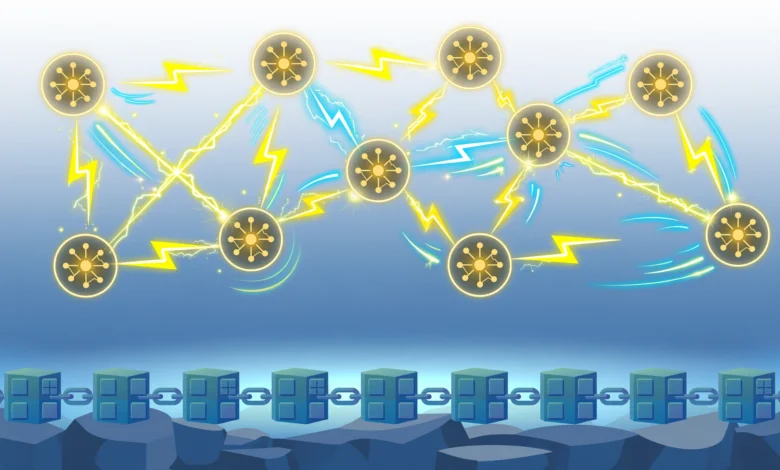
Bitcoin was designed as a peer-to-peer electronic cash system, but as adoption grew, a fundamental problem emerged: the Bitcoin blockchain simply can’t process transactions fast enough or cheaply enough to compete with traditional payment networks like Visa or Mastercard. This is where the Bitcoin Lightning Network comes in — a second-layer solution built on top of Bitcoin that enables near-instant, low-fee transactions while preserving the security of the underlying blockchain.
In this guide, we’ll break down exactly what the Lightning Network is, why it exists, how it technically works, and what its real-world benefits and limitations are.
What Is the Bitcoin Lightning Network?
The Bitcoin Lightning Network is a “Layer 2” payment protocol that operates on top of the Bitcoin blockchain (Layer 1). Instead of recording every single transaction directly on the blockchain, Lightning allows users to conduct an unlimited number of transactions off-chain, only settling the final balance on the Bitcoin blockchain when necessary.
Think of it like running a tab at a bar. Instead of paying with your card for every single drink (each transaction incurring a fee and taking time to process), you open a tab, order as many drinks as you want throughout the night, and settle the full bill once at the end. The Lightning Network works similarly — it lets users transact freely and settle net totals on the blockchain only when a payment channel closes.
This design directly addresses Bitcoin’s most cited limitation: scalability. The base Bitcoin blockchain can handle roughly 7 transactions per second, whereas the Lightning Network can theoretically handle millions of transactions per second across its network of channels.
Why Was the Lightning Network Created?
Bitcoin’s original design prioritizes security and decentralization over speed. Every transaction must be verified by thousands of nodes worldwide and included in a block, which is mined roughly every 10 minutes. This trade-off, while excellent for security, creates real bottlenecks:
- Slow confirmation times: Transactions can take minutes to hours during periods of network congestion.
- High fees: When the network is busy, transaction fees can spike to several dollars — or more — making small “micropayments” impractical.
- Limited throughput: Bitcoin’s block size and 10-minute block time cap how many transactions can be processed per second.
In 2015, developers Joseph Poon and Thaddeus Dryja published a whitepaper titled “The Bitcoin Lightning Network: Scalable Off-Chain Instant Payments,” proposing a solution that wouldn’t require changing Bitcoin’s core protocol. The network officially launched on the Bitcoin mainnet in 2018 and has been continuously developed since.
How Does the Lightning Network Work?
To understand how Lightning works, it helps to break it down into its core building blocks: payment channels, the network of channels, smart contracts, and routing.
1. Payment Channels
The foundation of the Lightning Network is the payment channel — a private, direct connection between two parties that allows them to send Bitcoin back and forth without broadcasting each transaction to the blockchain.


Here’s how a channel is created:
- Two users each lock up a certain amount of Bitcoin into a multi-signature wallet (a wallet requiring both parties’ signatures to move funds). This is recorded as a single transaction on the Bitcoin blockchain — this is called the funding transaction or “opening” the channel.
- Once the channel is open, both parties can send Bitcoin back and forth an unlimited number of times, instantly and with no fees, simply by updating a shared private ledger (called a “commitment transaction”) that tracks each party’s current balance.
- When either party wants to exit, they broadcast the final balance to the Bitcoin blockchain in a single closing transaction, which settles the net result of all the off-chain activity.
Only two transactions ever touch the blockchain — the opening and the closing — no matter how many payments occurred in between.
2. The Network of Channels
A single payment channel between two people would be useful but limited. The real power of Lightning comes from connecting many channels together into a mesh network.
You don’t need a direct channel with someone to pay them. As long as there’s a path of interconnected channels between you and the recipient — even through several intermediary nodes — a payment can be routed across that path. This is conceptually similar to how the internet routes data packets across multiple servers to reach a destination, rather than requiring a direct physical cable between every two computers.
3. Hashed Timelock Contracts (HTLCs)
Routing payments through strangers’ channels raises an obvious question: how do you trust intermediaries not to steal your funds mid-route? The answer is a cryptographic mechanism called a Hashed Timelock Contract (HTLC).
In simplified terms, an HTLC ensures that:
- Funds can only be claimed by the recipient if they can prove they received a valid cryptographic “preimage” (essentially a secret code) generated by the final destination of the payment.
- If the payment fails to complete along any point of the route within a set time limit, the funds are automatically returned to their original owner.
This all-or-nothing structure means intermediary nodes never actually have custody or control over the funds passing through them — they either forward the payment correctly and earn a small routing fee, or the transaction fails safely and reverses.
4. Routing and Pathfinding
When you send a Lightning payment, your wallet software automatically searches the network for the most efficient path — factoring in channel capacity, fees, and reliability — and routes the payment through a chain of nodes to the recipient. This entire process, from pathfinding to settlement, typically completes in under a second.
Larger, well-connected nodes with significant liquidity (called “routing nodes” or sometimes informally “hubs”) play a crucial role in keeping the network efficient by facilitating payments between users who don’t have a direct channel.
Key Benefits of the Lightning Network
Speed
Lightning transactions settle almost instantly — typically in milliseconds to a few seconds — compared to the 10+ minutes required for on-chain Bitcoin confirmation.
Low Fees
Because most transactions never touch the blockchain, Lightning payments cost a fraction of a cent, making it feasible to send micropayments (think: tipping content creators a few cents, or paying per article read) that would be economically impractical on the base layer.
Scalability
The Lightning Network dramatically increases Bitcoin’s transaction throughput. Since payments happen off-chain, the network isn’t bottlenecked by block size or block time, enabling theoretical capacity in the millions of transactions per second.
Privacy
Because Lightning transactions aren’t recorded individually on the public blockchain, they offer a greater degree of transaction privacy compared to standard on-chain Bitcoin transfers.
Preserves Bitcoin’s Security Model
Unlike some alternative scaling proposals, Lightning doesn’t require any changes to Bitcoin’s core consensus rules. It’s built as an additional layer, meaning it inherits Bitcoin’s underlying security while solving the speed and cost problem separately.
Real-World Use Cases
The Lightning Network has moved well beyond theory into practical, everyday use:
- Cross-border remittances: Sending money internationally in seconds for a fraction of a cent, bypassing traditional wire transfer fees and delays.
- Micropayments and content monetization: Platforms allow creators to receive tips or per-view payments as small as a few satoshis.
- Point-of-sale payments: Retailers in various countries accept Lightning payments for everyday purchases, from coffee to groceries.
- Gaming and streaming: In-game purchases and “pay-as-you-stream” models are enabled by Lightning’s ability to handle tiny, instant transactions.
- National adoption experiments: Some countries have explored Lightning-powered wallets as part of broader efforts to expand Bitcoin’s use as a means of payment.
Limitations and Challenges
No technology is without trade-offs, and Lightning is no exception.
- Liquidity requirements: Channels need to be funded (“liquidity”) in both directions to route payments effectively. If a channel is out of balance, payments may fail or need to be rerouted.
- Online requirement: Historically, nodes needed to remain online to protect against fraudulent channel closures, although “watchtower” services have emerged to mitigate this by monitoring channels on a user’s behalf.
- Routing complexity: While pathfinding is automated, extremely large payments can sometimes fail to route if no single path has sufficient liquidity.
- User experience: Managing channels, liquidity, and backups can still be more complex than a simple on-chain wallet, though wallet providers have made major strides in abstracting this complexity away.
- Custodial trade-offs: Many casual users access Lightning through custodial wallets (exchanges or apps that manage channels on their behalf) for convenience, which reintroduces a degree of counterparty trust that non-custodial Bitcoin usage aims to avoid.
Lightning Network vs. On-Chain Bitcoin: Quick Comparison
| Feature | On-Chain Bitcoin | Lightning Network |
|---|---|---|
| Speed | ~10 minutes per confirmation | Near-instant (milliseconds–seconds) |
| Fees | Variable, can be high during congestion | Typically fractions of a cent |
| Best for | Large, infrequent transactions | Small, frequent transactions |
| Privacy | Public ledger of all transactions | Transactions not individually recorded on-chain |
| Security model | Full blockchain consensus | Inherits Bitcoin security via smart contracts |
The Future of the Lightning Network
Development on Lightning continues at a rapid pace. Ongoing improvements include better liquidity management tools, simplified channel-opening experiences, splicing (adjusting channel capacity without closing it), and increased interoperability between wallets and service providers. As adoption grows, Lightning is increasingly viewed not as a replacement for Bitcoin’s base layer, but as a complementary system that lets Bitcoin function both as a secure store of value (Layer 1) and a fast, everyday medium of exchange (Layer 2).
Conclusion
The Bitcoin Lightning Network represents one of the most significant innovations in Bitcoin’s evolution, directly addressing the scalability challenges that once made everyday Bitcoin payments impractical. By enabling instant, low-cost transactions through a network of payment channels secured by cryptographic smart contracts, Lightning transforms Bitcoin from a system best suited for large, infrequent transfers into one capable of powering everyday commerce, micropayments, and global remittances — all while preserving the security guarantees of the underlying blockchain.
As the technology matures and user experience continues to improve, the Lightning Network is likely to play an increasingly central role in how people around the world use Bitcoin, not just as digital gold, but as functional, fast digital cash.