Proof of Work vs Proof of Stake Consensus Mechanisms Compared
Proof of Work vs Proof of Stake: Learn how these blockchain consensus mechanisms differ, their pros and cons, and which cryptocurrencies use them.

If you’ve spent any time reading about cryptocurrency, you’ve probably come across the terms Proof of Work and Proof of Stake. These aren’t just technical jargon that developers throw around. They’re the fundamental systems that keep blockchain networks secure, decentralized, and running smoothly. Think of them as the rulebooks that determine who gets to add new transactions to the blockchain and how they’re rewarded for doing it.
The debate between Proof of Work vs Proof of Stake has become one of the most important discussions in the crypto world, especially as concerns about energy consumption and scalability continue to grow. Bitcoin relies on Proof of Work, while Ethereum made the historic switch to Proof of Stake in 2022. Each approach has passionate defenders and critics.
Understanding these consensus mechanisms isn’t just for tech enthusiasts. Whether you’re investing in cryptocurrency, building blockchain applications, or simply curious about how this technology works, knowing the difference between these two systems will help you make better decisions. In this guide, we’ll break down how each mechanism works, compare their strengths and weaknesses, and help you understand why this choice matters so much for the future of blockchain technology.
What Is a Consensus Mechanism?
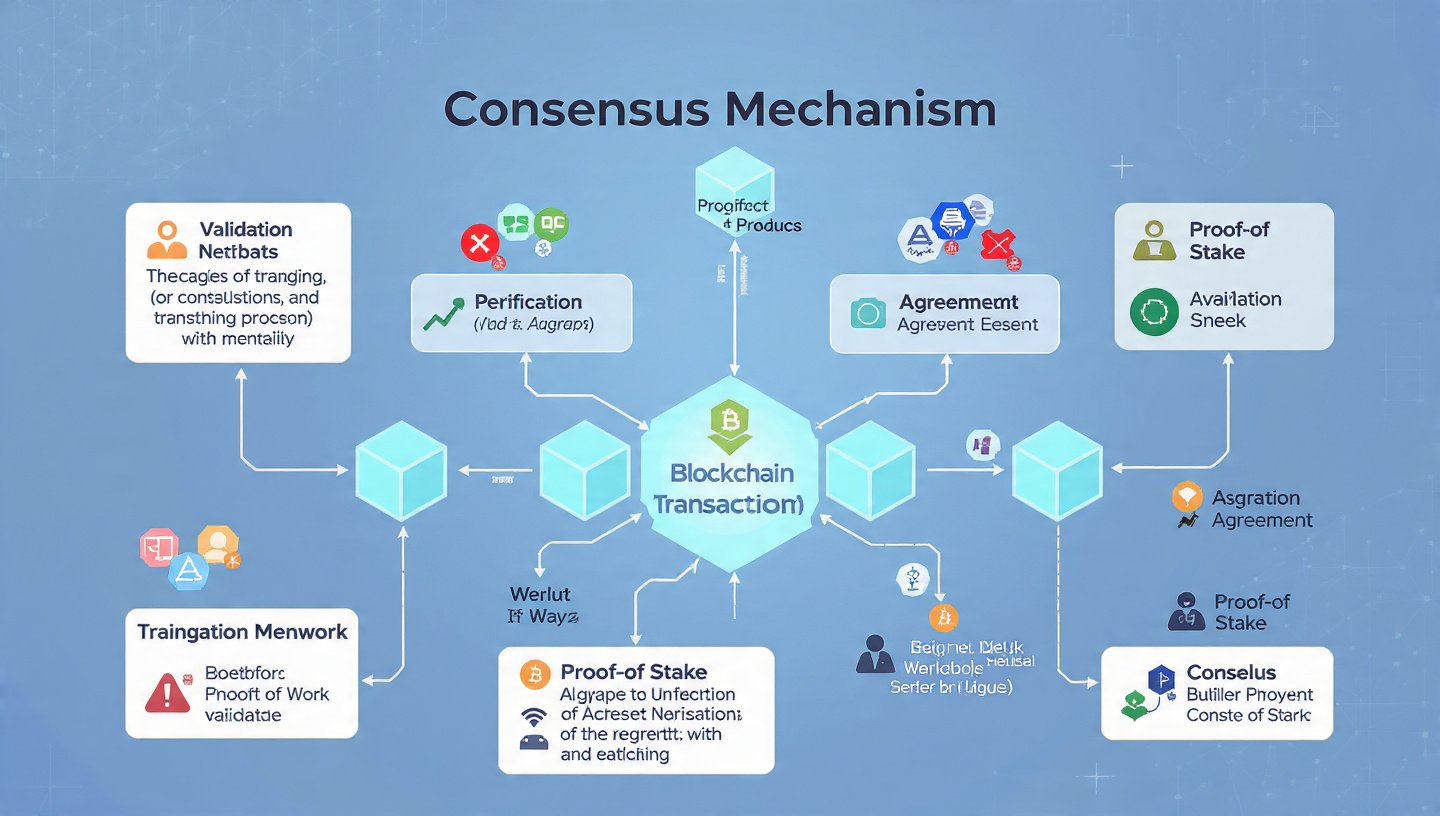
Before we dive into the specifics of Proof of Work and Proof of Stake, let’s establish what a consensus mechanism actually does.
In traditional finance, banks and payment processors act as trusted intermediaries. They verify transactions, maintain account balances, and prevent fraud. But blockchain networks operate differently. They’re decentralized systems where no single authority is in charge. So how does everyone agree on which transactions are valid?
That’s where consensus mechanisms come in. These are the protocols that allow thousands of computers (called nodes) spread across the world to agree on the current state of the blockchain without needing to trust each other. They answer critical questions like:
- Who gets to add the next block of transactions?
- How do we prevent someone from spending the same cryptocurrency twice?
- How do we reward participants for maintaining the network?
- How do we keep the system secure against attacks?
A good consensus mechanism needs to be:
- Secure: Resistant to attacks and manipulation
- Decentralized: Not controlled by any single party
- Efficient: Able to process transactions at a reasonable speed
- Fair: Giving participants appropriate opportunities and rewards
Different blockchain consensus algorithms solve these challenges in different ways, with Proof of Work and Proof of Stake representing the two most prominent approaches.


What Is Proof of Work (PoW)?
Proof of Work is the original consensus mechanism, introduced by Satoshi Nakamoto in the Bitcoin whitepaper back in 2008. It’s the system that launched the entire cryptocurrency revolution.
How Proof of Work Functions
Here’s how PoW mining works in practice:
- Transaction Collection: Miners gather pending transactions from the network’s memory pool
- Block Creation: They organize these transactions into a candidate block
- Puzzle Solving: Miners compete to solve a complex mathematical puzzle
- Hash Generation: They repeatedly calculate cryptographic hashes until they find one that meets specific criteria
- Block Validation: The first miner to find a valid solution broadcasts it to the network
- Reward Distribution: If other nodes verify the block is correct, the miner receives newly created cryptocurrency plus transaction fees
The “work” in Proof of Work refers to the computational effort required to solve these puzzles. The difficulty adjusts automatically to maintain a consistent block time, regardless of how many miners are participating.
Mining Hardware and Energy Requirements
In Bitcoin’s early days, people could mine using regular computers. Today, cryptocurrency mining has evolved into a specialized industry dominated by:
- ASIC Miners: Application-specific integrated circuits designed solely for mining specific cryptocurrencies
- Mining Pools: Groups of miners who combine their computational power and share rewards
- Mining Farms: Warehouses filled with thousands of mining machines running 24/7
This evolution has led to significant energy consumption. The Bitcoin network alone uses more electricity annually than some countries. According to the Cambridge Bitcoin Electricity Consumption Index, Bitcoin’s energy usage rivals that of nations like Argentina or Norway.
Cryptocurrencies Using Proof of Work
Bitcoin remains the flagship PoW cryptocurrency, but it’s not alone:
- Litecoin: Often called “silver to Bitcoin’s gold”
- Dogecoin: Originally created as a joke but now a substantial network
- Bitcoin Cash: A fork of Bitcoin designed for faster transactions
- Monero: Privacy-focused with ASIC-resistant mining
What Is Proof of Stake (PoS)?
Proof of Stake emerged as an alternative to address some of Proof of Work’s limitations. Instead of miners competing with computational power, PoS systems use validators who lock up cryptocurrency as collateral.
How Proof of Stake Works
The Proof of Stake mechanism operates quite differently:
- Staking: Users deposit (stake) their cryptocurrency to become validators
- Selection: The protocol selects validators to propose new blocks, often based on factors like stake size and random selection
- Validation: Other validators verify the proposed block
- Rewards: Validators earn transaction fees and sometimes newly created tokens
- Penalties: Validators who act maliciously can lose their staked funds (called “slashing”)
Instead of solving puzzles, validators are essentially putting up a security deposit. If they validate fraudulent transactions, they lose their deposit. This economic incentive keeps the system secure.
Staking Requirements and Rewards
Different PoS blockchains have varying requirements:
- Ethereum: Requires 32 ETH to run a validator node (though staking pools allow participation with less)
- Cardano: No minimum for staking, making it accessible to smaller holders
- Polkadot: Uses a nominated Proof of Stake system with dynamic staking amounts
Staking rewards typically range from 4% to 20% annually, depending on the network and total amount staked. These rewards come from transaction fees and, in some cases, new token issuance.
Popular Proof of Stake Cryptocurrencies
Several major blockchain platforms now use Proof of Stake:
- Ethereum: Made the historic switch from PoW to PoS in September 2022 (called “The Merge”)
- Cardano: Built on PoS from the ground up with academic research backing
- Solana: Uses a hybrid Proof of History + PoS system
- Avalanche: Features a unique consensus protocol with sub-second finality
- Polygon: Ethereum scaling solution using PoS
Proof of Work vs Proof of Stake: Key Differences
Let’s break down the major distinctions between these two consensus algorithms:
Energy Consumption
This is perhaps the most discussed difference:
- Proof of Work: Requires massive amounts of electricity to power mining equipment. Critics point to the environmental impact, while supporters argue that mining increasingly uses renewable energy and that the security benefits justify the cost.
- Proof of Stake: Uses roughly 99% less energy than Proof of Work, according to the Ethereum Foundation. Validators run on regular computers, and there’s no computational race consuming electricity.
Security Approach
- Proof of Work Security: Protected by the immense cost of acquiring enough mining power to attack the network. A “51% attack” would require controlling more than half of the network’s total hash rate, which becomes prohibitively expensive for established networks like Bitcoin.
- Proof of Stake Security: Protected by economic incentives. Attacking the network requires owning a large percentage of the staked cryptocurrency, and successful attacks would devalue the attacker’s own holdings. Additionally, malicious validators can have their stake “slashed” (taken away).
Decentralization
- Proof of Work: In theory, anyone with mining equipment can participate. In practice, mining has become concentrated among large operations with cheap electricity and economies of scale.
- Proof of Stake: Barriers to entry can be lower (depending on minimum stake requirements), but those with more cryptocurrency have proportionally more influence. However, some argue this is more democratic than PoW’s hardware requirements.
Environmental Impact
The environmental impact of cryptocurrency has become a major consideration:
PoW Environmental Concerns:
- High carbon footprint from electricity usage
- Electronic waste from outdated mining equipment
- Pressure on power grids in mining-heavy regions
PoS Environmental Benefits:
- Minimal energy requirements
- Significantly reduced carbon emissions
- No need for specialized hardware that becomes obsolete
Transaction Speed and Scalability
- Proof of Work: Generally slower, with Bitcoin processing about 7 transactions per second. The computational work required limits throughput.
- Proof of Stake: Can handle more transactions per second. Ethereum’s switch to PoS was a prerequisite for future scalability improvements that could enable thousands of transactions per second.
Advantages and Disadvantages
Proof of Work Advantages
- Battle-Tested Security: Bitcoin has operated securely for over 15 years without a successful attack on its consensus mechanism
- True Decentralization: Anyone can become a miner without permission
- Simple and Transparent: The rules are straightforward and well-understood
- Objective Verification: The longest chain with the most work is automatically the valid chain
Proof of Work Disadvantages
- Massive Energy Use: Creates environmental concerns and high operational costs
- Centralization Risk: Mining power has concentrated in regions with cheap electricity
- Hardware Requirements: Initial investment for competitive mining is substantial
- Limited Scalability: Processing speed is constrained by block time and size
- 51% Attack Vulnerability: Smaller PoW networks are vulnerable to well-funded attackers
Proof of Stake Advantages
- Energy Efficient: Uses a tiny fraction of the electricity compared to PoW
- Lower Barriers to Entry: You can participate by holding cryptocurrency rather than buying expensive hardware
- Better Scalability: Can process more transactions and enable layer-2 solutions more easily
- Economic Security: Attacking the network is expensive and self-defeating
- Flexibility: Easier to upgrade and implement new features
Proof of Stake Disadvantages
- Less Proven: Hasn’t been tested at Bitcoin’s scale and duration
- “Rich Get Richer”: Those with more stake earn proportionally more rewards
- Nothing at Stake Problem: Theoretical vulnerability where validators might validate multiple competing chains
- Initial Distribution: Critics question how tokens are distributed if no mining exists
- Complexity: More complex protocols can have unforeseen vulnerabilities
Which Consensus Mechanism Is Better?

There’s no universal answer to the Proof of Work vs Proof of Stake debate. The “better” choice depends on what you value most:
Choose Proof of Work If You Prioritize:
- Maximum security through proven methods: Bitcoin’s PoW has withstood every attack for 15+ years
- True permissionless participation: No one can prevent you from mining
- Objective finality: The chain with the most work is definitively correct
- Conservative approach: Prefer tried-and-tested technology
Choose Proof of Stake If You Prioritize:
- Environmental sustainability: Energy concerns are paramount
- Scalability potential: Need higher transaction throughput
- Accessibility: Want to participate without specialized hardware
- Evolution and upgrades: Value flexibility to implement improvements
According to the Ethereum Foundation’s research, the shift to Proof of Stake reduced Ethereum’s energy consumption by approximately 99.95%. This dramatic improvement addresses one of cryptocurrency’s biggest criticisms while maintaining security through economic incentives. Many blockchain developers are now exploring hybrid approaches or entirely new consensus mechanisms that try to capture the benefits of both systems while minimizing drawbacks.
The Future of Blockchain Consensus
The cryptocurrency ecosystem continues to evolve, and the consensus mechanism debate is far from settled:
Emerging Alternatives
Developers are experimenting with variations and entirely new approaches:
- Delegated Proof of Stake (DPoS): Used by EOS and TRON, where token holders vote for validator delegates
- Proof of History (PoH): Solana’s innovation that creates a historical record proving events occurred in a specific sequence
- Proof of Authority (PoA): Used in private blockchains where approved validators maintain the network
- Proof of Space: Uses hard drive space instead of computational power
- Byzantine Fault Tolerance variants: Different approaches to achieving consensus in distributed systems
Ethereum’s Impact
Ethereum’s successful transition from Proof of Work to Proof of Stake in September 2022 marked a watershed moment. As the second-largest cryptocurrency by market capitalization making this shift, Ethereum proved that major networks can evolve their consensus mechanisms.
This transition, called “The Merge,” demonstrated that:
- Large-scale consensus changes are possible
- Environmental concerns are being taken seriously
- PoS security can protect billions of dollars in value
Bitcoin’s Stance
Bitcoin mining continues unchanged, with the community generally resistant to changing the consensus mechanism. Arguments for keeping PoW include:
- Security through proven track record
- Conservative approach protects value
- Mining has improved efficiency and renewable energy usage
- The security model is well-understood
However, Bitcoin’s energy usage remains controversial, and pressure from regulators and environmental groups continues to mount.
Practical Implications for Investors and Users
Understanding consensus mechanisms has real-world implications:
For Investors
- Risk Assessment: PoW networks have proven security but face regulatory pressure over energy use
- Environmental Factors: ESG-conscious investors may prefer PoS cryptocurrencies
- Yield Opportunities: PoS networks offer staking rewards as passive income
- Long-term Viability: Consider which approach aligns with future regulations
For Developers
- Platform Choice: Your application’s requirements might favor one consensus type
- Scalability Needs: PoS generally offers better throughput potential
- Security Model: Consider which security approach fits your use case
- Energy Costs: PoW applications incur higher operational expenses
For Miners and Validators
- Capital Requirements: PoW needs hardware investment; PoS needs cryptocurrency holdings
- Ongoing Costs: Mining has high electricity costs; staking has minimal operational expenses
- Technical Expertise: Both require knowledge, but in different areas
- Profitability: Varies by network, competition, and market conditions
Conclusion
The Proof of Work vs Proof of Stake comparison reveals two fundamentally different approaches to securing blockchain networks. Proof of Work relies on computational power and energy expenditure to create an immutable record, offering battle-tested security that has protected Bitcoin for over 15 years. Proof of Stake uses economic incentives and collateral deposits, dramatically reducing energy consumption while maintaining security through different mechanisms. Neither is objectively “better” in all circumstances.
Bitcoin’s continued success with PoW demonstrates the value of a conservative, proven approach, while Ethereum’s transition to PoS shows that environmental concerns and scalability challenges can be addressed through evolution. As blockchain technology matures, we’ll likely see continued innovation in consensus mechanisms, with different networks choosing approaches that align with their specific goals and communities. Understanding these fundamental differences helps you make informed decisions whether you’re investing, building applications, or simply following the cryptocurrency space.