Market Cap Leaders: 10 Top Crypto Assets in North America and the Surprising Winners of 2026
The top 10 crypto assets by market cap for North American investors in 2026, with US and Canada ETF access, stablecoin rules, and what each asset does.

Market cap rankings are global, but the way people in North America actually buy, hold, and trade crypto is shaped by local rules. A coin can sit in the global top five and still be hard to buy on a regulated Canadian platform. Another can rank lower but be available in a U.S. spot ETF that any retirement account can hold. That gap between the global leaderboard and real-world access is what makes a North American view of the rankings worth having.
As of late September 2026, the total crypto market is worth about $2.87 trillion. Bitcoin alone accounts for roughly 58.5% of that. Behind it sits a mix of familiar names like Ethereum, XRP, and Solana, two giant stablecoins, and a couple of surprising newcomers to the top 10, including Zcash and Hyperliquid.
This guide covers the top crypto assets by market cap from a North American perspective. For each one, you’ll see its current market cap, what it does, how it ties to the United States or Canada, and how investors in the region can get exposure, whether through exchanges, ETFs, or both.
We’ll also walk through the regulatory picture on both sides of the border, since that shapes which assets are easy to own. All figures are rounded and based on data from September 25, 2026, so check live numbers before making any decisions.
Is There a North American Crypto Market Cap?
Not really, and it’s worth clearing this up first. A coin’s market cap is its price multiplied by its circulating supply, and prices are set on a global market that trades 24 hours a day. Bitcoin doesn’t have one market cap in Toronto and another in Tokyo.
What does differ by region is access. When people search for the top crypto assets in North America, they usually mean one of three things:
- The global leaders that North Americans can actually buy, on regulated exchanges or through funds.
- Assets with strong ties to the region, such as coins issued by U.S. companies or projects founded in the U.S. or Canada.
- The assets North American investors hold most, often through spot ETFs.
This market cap guide covers all three. We start with the global market cap ranking, then add the context that matters most for readers in the United States and Canada.
Why Location Still Matters
Even with a single global price and market cap, where you live affects your options:
- Product access. The U.S. and Canada both offer spot crypto ETFs, but not for the same assets at the same time. Canada launched North America’s first spot Bitcoin ETF back in 2021, while U.S. spot Bitcoin ETFs arrived in January 2024.
- Stablecoin rules. Canadian regulators set strict terms for stablecoins on registered platforms, which has limited access to some of the largest ones.
- Exchange availability. Some global exchanges and their native tokens have limited or no presence in North America.
- Taxes and reporting. Both countries treat crypto as property for tax purposes, so every sale or swap can trigger a taxable event.
Top 10 Crypto Assets by Market Cap: The North American View
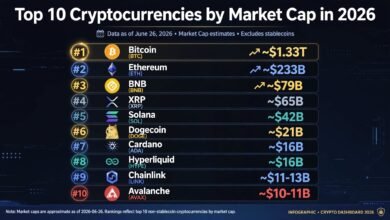
Here’s the global top 10 as of September 25, 2026, based on data from the Slickcharts cryptocurrency market cap table, with notes on North American ties and access.


| Rank | Asset | Market cap | Share of market | North American tie | U.S. spot ETF |
|---|---|---|---|---|---|
| 1 | Bitcoin (BTC) | ~$1.68 trillion | ~58.5% | Largest ETF market is in the U.S. | Yes |
| 2 | Ethereum (ETH) | ~$327 billion | ~11.4% | Co-founder Vitalik Buterin grew up in Toronto | Yes |
| 3 | Tether (USDT) | ~$184 billion | ~6.4% | Issued outside North America | Not applicable (stablecoin) |
| 4 | BNB (BNB) | ~$103 billion | ~3.6% | Linked to Binance, with limited U.S. access | Check current listings |
| 5 | XRP (XRP) | ~$98 billion | ~3.4% | Ripple is based in San Francisco | Yes |
| 6 | USDC (USDC) | ~$75 billion | ~2.6% | Issued by U.S.-based Circle | Not applicable (stablecoin) |
| 7 | Solana (SOL) | ~$71 billion | ~2.5% | Solana Labs started in San Francisco | Yes |
| 8 | TRON (TRX) | ~$32 billion | ~1.1% | Limited North American ties | Check current listings |
| 9 | Zcash (ZEC) | ~$26 billion | ~0.9% | Developed by a U.S.-based team | Yes |
| 10 | Hyperliquid (HYPE) | ~$23 billion | ~0.8% | Decentralized trading platform | Check current listings |
A few market cap patterns stand out right away. First, five of the top 10 have strong U.S. connections, either through their issuers, founders, or the funds that hold them. Second, two of the top six are stablecoins, which tells you how much of crypto’s activity now runs on digital dollars. And third, the bottom of the list has changed a lot this year, with Zcash and Hyperliquid pushing out older names like Dogecoin.
The Top 10 Crypto Assets by Market Cap, Explained for North American Investors
Here’s a closer look at each market cap leader, with what it does and how people in the United States and Canada can get exposure.
1. Bitcoin (BTC): The Undisputed Market Cap Leader
- Market cap: about $1.68 trillion
- Price: about $83,700
- Share of total market cap: about 58.5%
Bitcoin is the original cryptocurrency and still the anchor of the whole market. Its fixed supply of 21 million coins and long track record make it the asset most institutions start with.
North America plays a huge role in Bitcoin’s market cap today. Canada approved the first spot Bitcoin ETF on the continent in February 2021, and the U.S. followed in January 2024. U.S. spot Bitcoin ETFs have since become one of the biggest sources of demand for the asset. After seven months of outflows earlier this year, they pulled in about $3.52 billion in August 2026, helping Bitcoin climb from its July 1 low near $58,000 to an eight-month high above $87,000 in September.
For North American investors: Bitcoin is available on nearly every regulated exchange in both countries and through a wide range of spot ETFs.
2. Ethereum (ETH): The Platform With Canadian Roots
- Market cap: about $327 billion
- Price: about $2,680
- Share of total market cap: about 11.4%
Ethereum is the leading smart contract platform, powering most of the market’s decentralized finance apps, stablecoins, and tokenized assets. It has a genuine North American story too. Co-founder Vitalik Buterin grew up in Toronto, and several of Ethereum’s biggest development firms are based in the U.S.
Canada again moved first on funds, approving spot Ether ETFs in 2021. U.S. spot Ether ETFs launched in July 2024 and have seen renewed inflows in September 2026. Ethereum’s market cap has added close to $100 billion since mid-August, when ETH traded near $1,900.
For North American investors: ETH is widely available on exchanges and through spot ETFs in both countries.
3. Tether (USDT): The Largest Stablecoin, With Limits in Canada
- Market cap: about $184 billion
- Price: about $1.00
Tether is the most widely used stablecoin in the world, pegged to the U.S. dollar and used heavily for trading and cross-border payments. Its huge market cap puts it third on the global list.
North American access is more complicated. Tether’s issuer is based outside the region, and Canadian regulators have set strict conditions for stablecoins on registered trading platforms. As a result, many regulated Canadian platforms stopped offering USDT. In the U.S., the GENIUS Act, signed into law in July 2025, created a federal framework for payment stablecoins, raising the bar for issuers who want to serve American users.
For North American investors: Many prefer U.S.-regulated stablecoins such as USDC for everyday use, especially in Canada.
4. BNB (BNB): A Global Giant With a Small North American Footprint
- Market cap: about $103 billion
- Price: about $772
BNB powers BNB Chain and offers benefits on the Binance exchange. It moved ahead of XRP in market cap this month, taking fourth place on the global list.
BNB’s North American footprint is limited. Binance’s main exchange doesn’t serve U.S. customers, which are handled by a separate company, Binance.US. Binance also left Canada in 2023 after the country tightened its rules for crypto platforms. That makes BNB one of the harder top 10 assets for people in the region to buy on large, regulated platforms.
For North American investors: Check whether your exchange lists BNB before counting on it as part of your portfolio.
5. XRP (XRP): A Payments Token From San Francisco
- Market cap: about $98 billion
- Price: about $1.56
XRP runs on the XRP Ledger and is closely tied to Ripple, a payments company headquartered in San Francisco. Ripple uses XRP in some of its cross-border settlement products and also issues its own U.S. dollar stablecoin, RLUSD.
XRP spent years at the center of a legal fight with the SEC, which ended in 2025. U.S. spot XRP ETFs followed later that year. XRP slipped to fifth place by market cap in September 2026 after BNB passed it, but the gap between them is only about $5 billion, so their order could flip again quickly.
For North American investors: XRP is broadly available on U.S. and Canadian exchanges and through U.S. spot ETFs.
6. USDC (USDC): The U.S.-Regulated Stablecoin
- Market cap: about $75 billion
- Price: about $1.00
USDC is issued by Circle, a U.S. company that listed its shares on the New York Stock Exchange in 2025. It’s backed by cash and short-term U.S. government securities, and Circle publishes regular reports on its reserves.
For North Americans, USDC is often the default stablecoin, despite its smaller market cap than Tether. It remains widely available on registered Canadian platforms, and its U.S. roots put it in a strong position under the GENIUS Act framework. Together with Tether, it’s part of a stablecoin market cap that passed $320 billion in 2026.
For North American investors: USDC is the most accessible large stablecoin in both countries and is often used for moving money between exchanges or earning yield on platforms that offer it.
7. Solana (SOL): Built in San Francisco, Backed by ETF Demand
- Market cap: about $71 billion
- Price: about $121
Solana is a fast, low-cost blockchain used for trading, payments, and consumer apps. It was created by Solana Labs, a company founded in San Francisco.
Solana has been one of the strongest large market cap performers of 2026’s second half, rising from about $78 in mid-August. Canada approved spot Solana ETFs in April 2025, and U.S. spot Solana ETFs followed later that year. By late September 2026, U.S. Solana funds had recorded 12 consecutive weeks of inflows. Solana has also become a leading home for tokenized U.S. stocks after regulators opened a legal path for them.
For North American investors: SOL is widely available on exchanges and through spot ETFs in both the U.S. and Canada.
8. TRON (TRX): A Stablecoin Highway With Few North American Ties
- Market cap: about $32 billion
- Price: about $0.34
TRON is a blockchain founded by Justin Sun. It’s best known as a major network for moving USDT, especially in parts of Asia, Africa, and Latin America where low fees matter.
TRON has fewer direct links to North America than most assets on this list, and it gets far less attention from North American institutions. Its market cap is driven largely by stablecoin activity elsewhere in the world.
For North American investors: TRX is listed on some exchanges in the region, but availability varies, so check your platform first.
9. Zcash (ZEC): The Year’s Biggest Market Cap Surprise
- Market cap: about $26 billion
- Price: about $1,536
Zcash is a privacy-focused cryptocurrency developed by a U.S.-based team. It lets users shield transaction details using advanced cryptography.
Few assets had a bigger 2026. Zcash ranked around 82nd by market cap less than a year ago. Then Grayscale launched a spot Zcash ETF on NYSE Arca on August 25, 2026, and ZEC surged past $1,600 by late September. That rally pushed Zcash into the global market cap top 10. It’s a clear example of how a single North American fund launch can reshape the rankings.
For North American investors: ZEC is available through the U.S. spot ETF and on some exchanges, though a few platforms restrict privacy coins, so availability varies.
10. Hyperliquid (HYPE): The DeFi Newcomer
- Market cap: about $23 billion
- Price: about $91
Hyperliquid is a decentralized trading platform for perpetual futures and spot markets, running on its own blockchain. Its HYPE token passed Dogecoin to enter the top 10 on June 1, 2026, making it one of the few decentralized finance tokens ever to reach that level.
Hyperliquid’s market cap growth has been global, and its connection to North America is less direct than the U.S.-linked assets above. Access for users in the region can depend on the platform’s own terms and on which centralized exchanges list HYPE.
For North American investors: Check local availability and platform terms carefully before buying.
North American Crypto Projects Just Outside the Top 10
Several well-known assets with strong U.S. roots sit just below the top 10 by market cap. They’re worth watching because they often benefit from North American regulation and institutional interest:
- Stellar (XLM): about $7.6 billion. A payments network run by the San Francisco-based Stellar Development Foundation.
- Uniswap (UNI): about $5.9 billion. The largest decentralized exchange protocol, developed by a New York-based company.
- Avalanche (AVAX): about $4.6 billion. A smart contract platform developed by Ava Labs, also based in New York.
- Hedera (HBAR): about $4.1 billion. An enterprise-focused network with a council of large global companies.
- U.S. dollar stablecoins from American firms: World Liberty Financial USD (about $4.4 billion), Global Dollar (about $3.2 billion), PayPal USD (about $2.7 billion), and Ripple USD (about $2.5 billion).
That last group is growing fast. Since the GENIUS Act passed, more U.S. companies have launched their own digital dollars, and their combined market cap keeps rising.
Winners and Losers in the 2026 Market Cap Rankings
The title of this guide promised some surprising winners, and 2026 delivered. Here’s how the top of the market cap table has shifted this year:
- Zcash jumped from outside the top 80 by market cap into the top 10, powered by a new U.S. spot ETF.
- Hyperliquid entered the top 10 on June 1, one of the few DeFi tokens ever to do so.
- BNB passed XRP for fourth place in September, although the gap is small.
- Solana added more than 50% to its market cap from its mid-August low, backed by steady ETF inflows.
- Dogecoin dropped out of the top 10 and now sits around 11th with a market cap near $15 billion.
The broader lesson is that North American products, especially spot ETFs, now have real power to move global market cap rankings. When a new U.S. fund opens the door for mainstream investors, the effect can show up in the rankings within weeks.
The Regulatory Picture in the U.S. and Canada
Rules on both sides of the border shape which crypto assets are easy to own, and that can influence their market cap over time. Here’s a quick overview.
United States
- Spot ETFs: The U.S. now has spot ETFs for Bitcoin, Ethereum, Solana, XRP, and Zcash, among others, giving investors exposure to most of the largest market cap assets through ordinary brokerage accounts.
- Stablecoins: The GENIUS Act of 2025 set federal standards for payment stablecoin issuers, including reserve and disclosure rules.
- Market structure: The Clarity Act, which would have set broader rules for crypto markets, failed a key Senate vote on September 15, 2026. Most observers now expect that debate to continue into 2027, while the SEC and CFTC work on their own rules.
- Taxes: The IRS treats crypto as property, so capital gains rules apply to sales, swaps, and spending.
Canada
- Early ETF leader: Canada approved North America’s first spot Bitcoin and Ether ETFs in 2021 and spot Solana ETFs in April 2025.
- Platform registration: Crypto trading platforms must register with provincial securities regulators and follow the Canadian Securities Administrators’ rules, which include limits on how much some retail investors can buy of certain assets.
- Stablecoin conditions: Regulators require stablecoin issuers to meet strict conditions before their tokens can trade on registered platforms. That’s why USDC is widely available in Canada while USDT, despite its larger market cap, has been delisted by many platforms.
- Taxes: The Canada Revenue Agency treats crypto as a commodity, and gains are taxed as either capital gains or business income depending on how you trade.
How to Buy the Top Market Cap Crypto Assets in North America
Here’s a practical path for buying the top market cap assets:
- Decide between direct ownership and funds. Spot ETFs are simple and fit into regular brokerage and retirement accounts. Owning coins directly gives you more control but means handling storage and security yourself.
- Pick a regulated platform. In the U.S., look for exchanges licensed in your state. In Canada, use a platform registered with the Canadian Securities Administrators.
- Check what’s listed. Not every top 10 market cap asset is available on every platform, especially BNB, TRX, and HYPE.
- Compare fees. Trading fees, spreads, and ETF expense ratios all eat into returns over time.
- Plan for storage. If you hold coins directly, consider a hardware wallet for larger amounts.
- Keep records for taxes. Track every purchase, sale, and swap, since both countries tax crypto gains, and good records make filing season much easier.
This article is for information only and isn’t financial advice. Crypto prices are highly volatile, so never invest more than you can afford to lose.
Frequently Asked Questions
What is the largest crypto asset by market cap in North America?
Bitcoin, by a wide margin. Market cap is set globally, and Bitcoin’s is about $1.68 trillion, or roughly 58.5% of the total crypto market. It’s also the most widely held crypto asset in North America through spot ETFs.
Which top 10 market cap assets are tied to the United States?
USDC is issued by U.S.-based Circle, and XRP is closely tied to San Francisco-based Ripple. Solana was created by a San Francisco company, and Zcash is developed by a U.S.-based team. Ethereum also has a Canadian connection through co-founder Vitalik Buterin.
Can Canadians buy USDT?
Many registered Canadian platforms no longer offer USDT because of the country’s stablecoin rules. USDC is the more common option for Canadians who want a U.S. dollar stablecoin.
Where can I check live crypto market cap rankings?
Data sites such as CoinMarketCap, CoinGecko, and the CoinDesk crypto price and market cap page update rankings in real time. Checking more than one source is a good habit, since figures can differ slightly.
Why did Dogecoin drop out of the market cap top 10?
Dogecoin’s market cap didn’t keep pace with newer assets. Zcash and Hyperliquid both grew quickly in 2026, pushing Dogecoin’s market cap rank down to about 11th.
Conclusion
The top crypto assets by market cap look the same in North America as everywhere else, since prices are set globally, but access, regulation, and local ties give the rankings a distinct shape for U.S. and Canadian investors: Bitcoin leads with a market cap of about $1.68 trillion and deep ETF demand, Ethereum follows with Canadian roots, USDT and BNB rank high globally but face real limits in the region, XRP, USDC, Solana, and Zcash carry strong U.S. connections and growing ETF access, TRON and Hyperliquid round out a top 10 that has changed dramatically this year, and the smartest move for anyone in North America is to check which assets their platform supports, understand the rules on their side of the border, and treat market cap as a starting point rather than the final word on any investment, then revisit those checks often because rankings shift quickly.