Top 10 Cryptocurrencies by Market Cap in 2026: The Ultimate Guide to the Biggest Winners
Top 10 cryptocurrencies by market cap in 2026, ranked and explained, with what drove each coin's growth and what to watch next.
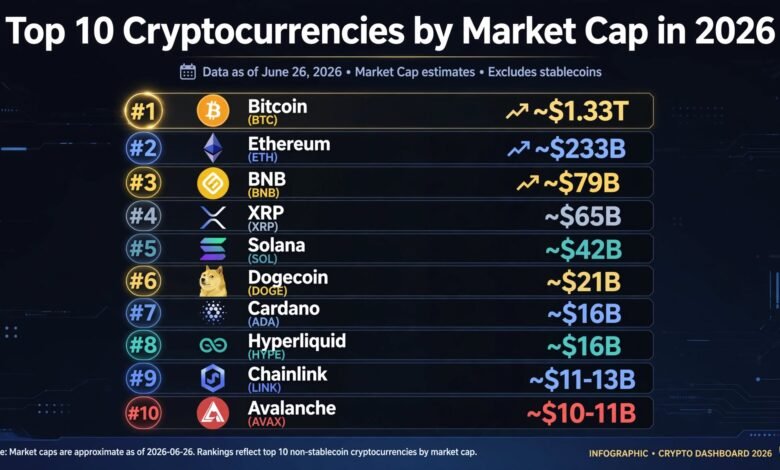
Top 10 cryptocurrencies by market cap is the question every investor asks before putting money into digital assets, and 2026 has given us a genuinely different leaderboard than the one crypto fans got used to a few years ago. Institutional money has settled in, regulation has caught up in most major markets, and a handful of coins have separated themselves from the pack through actual use rather than hype alone.
If you’ve been away from the market for a while, or you’re just getting started, the shifts are worth paying attention to. Bitcoin still sits at the top, but the gap between it and the rest has changed shape. Ethereum has fought off years of “flippening” chatter from newer chains. Stablecoins now make up a bigger slice of the top ten than most people expect, which says a lot about how crypto is actually being used day to day, not just traded.
This guide walks through the ten largest cryptocurrencies by market capitalization, what each one does, why it has held its position (or climbed), and what risks or catalysts are worth watching going forward. We’ll also cover how market cap is calculated, why it matters more than price alone, and how to think about this list if you’re building or rebalancing a portfolio.
One quick note before we dive in: crypto market caps move by the hour. The rankings below reflect the general shape of the market as of early 2026. Always check a live source like CoinMarketCap or CoinGecko for the exact numbers on the day you’re reading this.
What Does Market Cap Actually Mean in Crypto?
Before ranking anything, it helps to be clear on what we’re measuring. Market capitalization is calculated by multiplying a coin’s current price by its circulating supply. It’s not a measure of how much money has flowed into a coin, and it’s not the same as trading volume.
A few things worth keeping in mind:
- Price alone is misleading. A coin priced at $0.001 isn’t automatically “cheaper” or a better buy than one priced at $60,000. What matters is total value across all circulating coins.
- Circulating supply varies wildly. Some projects have capped supplies (like Bitcoin’s 21 million), while others mint new tokens continuously, which dilutes value over time if demand doesn’t keep pace.
- Market cap reflects market sentiment, not intrinsic value. It tells you what the market currently believes a coin is worth, not what it should be worth.
Understanding this helps explain why the top 10 cryptocurrencies by market cap list looks the way it does. Size here reflects trust, liquidity, and adoption more than raw price.
The Top 10 Cryptocurrencies by Market Cap in 2026
Here’s the current picture of the biggest digital assets in the market, along with what’s kept each one relevant.
1. Bitcoin (BTC)
Bitcoin remains the largest cryptocurrency by a wide margin, and that’s unlikely to change anytime soon. Its position is built on a few durable advantages:


- First-mover trust. Bitcoin has run continuously since 2009 without a single successful attack on its core protocol.
- Fixed supply. With a hard cap of 21 million coins, Bitcoin’s scarcity story has only gotten stronger as institutional buyers, including spot ETF holders, keep absorbing supply.
- Store-of-value narrative. More treasuries, pension funds, and public companies now hold Bitcoin as a hedge against currency debasement, similar to how some allocate to gold.
The main knock against Bitcoin is that it’s not built for fast, cheap transactions at scale. Layer-2 networks built on top of it are helping, but Bitcoin’s core use case is still “digital gold” rather than a payments network.
2. Ethereum (ETH)
Ethereum holds the number two spot as the backbone of decentralized finance, NFTs, and smart contracts. A few reasons it’s kept its footing:
- Network effects. The vast majority of DeFi protocols, tokenized assets, and Web3 applications are built on Ethereum or its Layer-2s.
- Post-merge efficiency. The move to proof-of-stake years ago cut energy use dramatically and turned ETH into a yield-bearing asset through staking.
- Institutional tokenization. Real-world assets, from treasury bonds to real estate funds, are increasingly being issued on Ethereum rails.
Ethereum’s biggest challenge is competition from faster, cheaper chains that have chipped away at its dominance in specific niches like gaming and high-frequency trading.
3. Tether (USDT)
Tether is the largest stablecoin and consistently ranks in the top three or four by market cap. It’s pegged 1:1 to the US dollar and is used mainly as:
- A trading pair on nearly every crypto exchange
- A way to move dollars across borders without a bank
- A safe harbor during market volatility
Tether has faced ongoing scrutiny over the composition of its reserves, and that remains the biggest risk factor for anyone holding large amounts of it.
4. BNB (BNB)
BNB, the native token of the Binance ecosystem, has held its top-five position through:
- Utility. BNB is used for trading fee discounts, gas fees on the BNB Chain, and participation in token launches.
- Active burn mechanism. Binance periodically burns BNB tokens, reducing supply over time.
- A large, active user base across Binance’s exchange and BNB Chain’s DeFi applications.
Regulatory pressure on centralized exchanges is the main risk hanging over BNB, since its value is closely tied to Binance’s business.
5. Solana (SOL)
Solana has cemented itself as a top-five asset thanks to raw performance. It handles thousands of transactions per second at a fraction of Ethereum’s cost, which has made it the chain of choice for:
- Meme coin trading and speculative activity
- Consumer-facing apps that need speed
- A growing number of tokenized funds and payment apps
Solana has had network outages in the past, and reliability concerns still come up, but its developer activity and user growth have kept it firmly in the top ten.
6. XRP (XRP)
XRP, tied to Ripple, is built specifically for cross-border payments and settlement between financial institutions. Its resurgence has been driven by:
- A resolved regulatory landscape after years of legal uncertainty with the SEC
- Growing partnerships with banks and payment providers using RippleNet
- Fast, low-cost settlement compared to traditional wire transfers
XRP’s value is closely tied to actual banking adoption, which makes it more sensitive to real-world partnership news than speculative hype.
7. USD Coin (USDC)
USDC, issued by Circle, is the second-largest stablecoin and a favorite among institutions for its transparency. Key points:
- Reserves are held in cash and short-term US Treasuries, audited regularly
- Widely integrated into payment apps, DeFi protocols, and even traditional fintech products
- Seen as the more “regulator-friendly” stablecoin compared to Tether
Its rise reflects a broader trend: stablecoins are becoming financial infrastructure, not just trading tools.
8. Cardano (ADA)
Cardano built its reputation on a research-first, peer-reviewed approach to blockchain development. It’s stayed in the top ten because of:
- A loyal, long-term holder base
- Ongoing development of smart contract capabilities and governance tools
- Use in emerging markets for identity and supply chain projects
Critics point out that Cardano’s development pace has historically lagged behind competitors, and adoption of its DeFi ecosystem remains smaller than Ethereum’s or Solana’s.
9. Dogecoin (DOGE)
Dogecoin remains, somewhat improbably, one of the largest cryptocurrencies by market cap. It’s held on through:
- A massive, engaged community
- High-profile endorsements and mentions from public figures
- Growing merchant acceptance for small payments
Dogecoin doesn’t have the same technical roadmap as most of this list, and its price action tends to be driven more by sentiment and social media than fundamentals.
10. TRON (TRX)
TRON rounds out the top ten, largely on the strength of its role in stablecoin transfers. A few reasons it’s stayed relevant:
- It processes a huge share of global USDT transactions due to low fees
- Strong adoption in regions with high demand for dollar-denominated stablecoins
- An active DeFi and gambling dApp ecosystem
TRON’s dominance is fairly narrow and concentrated in stablecoin settlement, which makes it more exposed than others to shifts in stablecoin regulation.
What’s Driving the Top 10 Cryptocurrencies by Market Cap This Year
A few broader trends explain why this list looks the way it does in 2026:
- Institutional adoption has matured. Spot ETFs, corporate treasury allocations, and regulated custody services have brought serious capital into Bitcoin and Ethereum specifically.
- Stablecoins have become core infrastructure. With USDT, USDC, and others in the top ten, it’s clear stablecoins are being used for actual payments and settlement, not just as trading tools.
- Regulatory clarity has rewarded compliant projects. Coins like XRP and USDC have benefited from clearer legal footing, while projects operating in gray areas face more scrutiny.
- Speed and cost still matter. Solana’s rise shows that developers and users continue to migrate toward chains that offer better throughput and lower fees.
How to Evaluate These Coins Beyond Market Cap
Market cap is a useful starting point, but it shouldn’t be the only thing you look at. When researching any coin on this list, also consider:
- Trading volume: Low volume relative to market cap can signal thin liquidity, which makes prices easier to manipulate.
- Developer activity: Active GitHub repositories and regular protocol upgrades are a decent proxy for long-term health.
- Real-world usage: Transaction counts, active wallets, and actual payment volume matter more than price speculation.
- Regulatory exposure: Some coins face more legal uncertainty than others depending on where you live and where the project is based.
- Concentration risk: Check how much supply is held by a small number of wallets, since heavy concentration can lead to sudden price swings.
Frequently Asked Questions
Is Bitcoin still the safest cryptocurrency to hold? Relative to other digital assets, yes. It has the longest track record, deepest liquidity, and most institutional support. That doesn’t make it risk-free, since crypto as an asset class remains far more volatile than traditional stocks or bonds.
Why are there so many stablecoins in the top 10? Stablecoins are used constantly for trading, remittances, and moving money across borders. Their market cap reflects actual dollar demand parked in crypto form, not speculative trading.
Could this ranking change significantly by next year? Yes. Crypto rankings shift based on regulation, technology upgrades, and shifts in investor sentiment. A coin outside the top ten today could break in with the right catalyst, and any coin on this list could drop out if adoption stalls.
Should I only invest in top 10 cryptocurrencies? Not necessarily, but sticking to larger, more established coins generally means better liquidity and lower risk of a project failing outright. Smaller coins can offer higher upside but come with significantly more risk.
Final Thoughts
The top 10 cryptocurrencies by market cap in 2026 tell a clear story: the market has moved past pure speculation toward real usage, regulatory clarity, and institutional trust. Bitcoin and Ethereum remain the anchors, stablecoins like Tether and USDC have proven their staying power as financial infrastructure, and newer entrants like Solana and XRP show that performance and real-world partnerships can push a coin into the top tier. Whether you’re investing, building, or just trying to understand where the industry is headed, this list is a solid snapshot of where trust and capital have concentrated, though it’s worth remembering that crypto rankings can shift quickly, so checking a live tracker before making any decisions is always a smart move.