Market Cap Rankings 2026: 7 Stunning Winners and Losers of the Year
Market cap rankings for 2026 show Nvidia on top, memory chipmakers soaring and software giants slipping. See the year's biggest winners and losers.
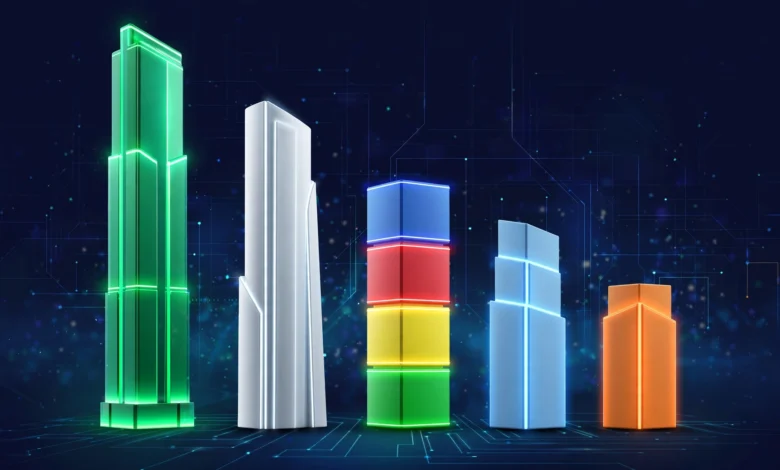
Market cap rankings are one of the quickest ways to see which companies the stock market loves and which ones it has lost patience with. In 2026, that picture changed faster than almost anyone expected. A few companies that barely made headlines two years ago are now worth more than a trillion dollars. Some of the most trusted names in tech spent months sliding down the leaderboard.
The short version is this: artificial intelligence spending decided almost everything. Companies that sell the hardware AI needs, especially memory chips, had a historic run. Companies whose products investors think AI might replace, mostly software businesses, got punished. And one giant private company, SpaceX, finally went public and jumped straight into the top tier.
This article walks through the 2026 market cap rankings from start to finish. You will see where the largest companies by market cap stood in January compared to September, which stocks gained the most value, which ones gave it back, and what forces were behind those moves. We will also look at how the trillion-dollar club grew, what the rankings can and cannot tell you, and what to watch for in the final months of the year.
If you invest, follow markets, or just want to understand why your news feed keeps mentioning memory chips, this breakdown should make the year a lot easier to follow. One note before we start: the numbers here move every trading day, so treat them as a snapshot, not a final scoreboard.
What Market Cap Rankings Actually Measure
Before getting into winners and losers, it helps to be clear about what these lists show. Market capitalization is the share price multiplied by the number of shares outstanding. That’s it. It tells you what the stock market is willing to pay for the whole company on a given day.
That simple math has a few consequences worth keeping in mind when you read market cap rankings:
- It reflects expectations, not just results. A company can have lower revenue than a rival and still rank higher because investors expect faster growth.
- It changes daily. A single earnings report, analyst upgrade, or macro headline can push a company up or down several spots within a week.
- It is not the same as company size. Walmart has far more employees and revenue than most chip companies, but it sits well below them in the most valuable companies lists.
- Different sources count differently. Some lists only include U.S.-listed stocks. Others include foreign exchanges, dual-class shares, or state-owned companies like Saudi Aramco. That is why two sites can show slightly different numbers for the same day.
So when we talk about winners and losers in the market cap rankings, we mean companies whose total market value rose or fell the most, either in dollars or in percentage terms. Both views matter. A 600% gain in a smaller company and a $1 trillion gain in a giant tell very different stories.
Market Cap Rankings in 2026: The Big Picture
The overall market had a decent year despite some real headwinds. According to Forbes, stocks were up roughly 11% as of early June, even with the Iran war and a jump in inflation, while hyperscalers like Google, Microsoft, Amazon and Meta were expected to raise capital spending by 63% to $670 billion this year. That spending is the single most important fact behind the 2026 market cap rankings. Money that big has to land somewhere, and the companies catching it saw their valuations explode. Forbes
The Top Five: January vs. September
Here’s how the very top of the leaderboard shifted. At the start of the year, AlphaSense data showed Nvidia leading at $4.56 trillion, followed by Apple at $3.95 trillion, Alphabet at $3.83 trillion, Microsoft at $3.53 trillion and Amazon at $2.49 trillion. By mid-September, StockTitan’s rankings put Nvidia at $5.12 trillion, Apple at $4.85 trillion, Alphabet at $4.22 trillion and Microsoft at $3.75 trillion, while AlphaSense had Amazon at about $2.78 trillion. largest companies by market cap +2


| Rank | Company | Early January 2026 | Mid-September 2026 | Approx. Change |
|---|---|---|---|---|
| 1 | Nvidia | $4.56T | $5.12T | +$560B |
| 2 | Apple | $3.95T | $4.85T | +$900B |
| 3 | Alphabet | $3.83T | $4.22T | +$390B |
| 4 | Microsoft | $3.53T | $3.75T | +$220B |
| 5 | Amazon | $2.49T | $2.78T | +$290B |
On the surface, the top five look stable. Same names, same order. But that table hides a wild ride in between, especially for Microsoft, which spent much of the year near the bottom of the Magnificent Seven before recovering. The real drama in the 2026 market cap rankings happened just below the top five.
Why the Leaderboard Looks So Top Heavy
The concentration at the top of the market keeps growing. A Yahoo Finance piece in late May noted that the $1 trillion club had grown to 14 members worth a combined $35 trillion or so, which is slightly more than U.S. GDP, and that back in 2018 Apple was the only member. That means a handful of stocks now drive a huge share of index returns. When those names move, your index fund moves with them, whether you meant to bet on them or not. Yahoo Finance
The Biggest Winners in the 2026 Market Cap Rankings
Now for the fun part. These are the companies that climbed the market cap rankings the fastest or added the most value this year.
1. Nvidia: Still the King
Nvidia stayed on top of the market cap rankings all year and crossed the $5 trillion line. Its lead over Apple narrowed at times, but it never gave up the number one spot. The company remains the main supplier of the chips that power AI data centers, and every increase in hyperscaler spending shows up in its revenue.
What makes Nvidia’s year interesting is that it was not the best performer in percentage terms. It was already so large that even strong gains looked modest next to smaller chip stocks. Still, adding roughly half a trillion dollars in market value in under nine months is not something most companies ever do in their entire history.
2. Memory Chipmakers: Micron, SK Hynix and Samsung
If you had to pick one group that defined the 2026 market cap rankings, it would be memory chip makers. For years, memory was treated as a boring, cyclical business. This year, it became the hottest corner of the market.
The reason is a supply crunch. Forbes reported that memory chip supply has fallen well short of demand, pushing prices up by as much as 355% in 2026, and the shortage could last until 2028. AI accelerators need huge amounts of high-bandwidth memory, and only three companies make most of it. Forbes
That led to a moment nobody would have predicted two years ago. In late May, SK Hynix joined Samsung Electronics and Micron Technology above the $1 trillion mark, so all three major memory makers held trillion-dollar valuations at the same time. CNN’s report on SK Hynix joining the trillion-dollar club points out that these three companies together produce nearly all of the world’s memory chips. ANI NewsCNN
A few details show how extreme the run was:
- Micron’s speed: MarketScreener, citing Wall Street Journal math, noted that Micron needed only 48 trading sessions to go from a $500 billion valuation to $1 trillion. It briefly crossed that threshold on May 26 after a UBS upgrade sent shares up 18% in one day. MarketScreenerCrypto Briefing
- Valuation still looked reasonable: Even after the surge, Micron traded at around 15 times its 2026 earnings, which is cheap by chip stock standards. MarketScreener
- SK Hynix’s gains: The Korean company rose 215% from the start of the year and 911% over twelve months. MarketScreener
- Korea’s new weight: SK Hynix and Samsung now make up half of the KOSPI’s total market capitalization, which says a lot about how concentrated that market has become. MarketScreener
SK Hynix also expanded its reach to U.S. investors. The Motley Fool notes that the company made its U.S. stock market debut in July 2026, which puts it directly in American market cap rankings for the first time. The Motley Fool
3. SanDisk and Western Digital: The Storage Surprise
Memory chips were not the only hardware story. Storage companies had a huge year too, and in percentage terms they topped the charts.
ChartRow’s performance data shows that among the top 100 companies by value, the best 2026 performer is SanDisk, up 654.8% year to date. That is one of the most remarkable runs for a large company in recent memory. Forbes explains that SanDisk has signed three multi-year supply agreements worth $42 billion so far, and Gartner expects NAND flash prices to climb as much as 234% in 2026. ChartRowForbes
Western Digital rode the same wave from a different angle. AI models produce enormous amounts of data that needs to be stored cheaply, and hard drives are still the cheapest option at scale. For a deeper look at both names, Forbes’ running list of 2026 stock winners and losers is worth reading.
One caveat: these stocks swing hard in both directions. In a single week in September, Lam Research fell 14.8%, SanDisk dropped 13.8% and SK hynix slid 12.0%. Big winners in the market cap rankings can lose a lot of ground quickly. Stock Titan
4. Apple: The Quiet Dollar Winner
Apple doesn’t usually get lumped in with AI winners, but in raw dollar terms it had one of the best years of any company in the market cap rankings. Going from about $3.95 trillion to roughly $4.85 trillion means it added close to $900 billion in value, more than Nvidia added over the same stretch.
The year also brought a major leadership change. According to The Motley Fool, Tim Cook stepped down as CEO on Sept. 1, 2026, after 15 years, and John Ternus, who had led hardware engineering, took over. The Fool also noted that Apple was outsourcing part of Apple Intelligence to Google as of 2026, which suggests investors cared more about Apple’s hardware and services strength than about whether it built every AI model itself. The Motley FoolThe Motley Fool
5. Alphabet: A Steady Climber
Alphabet held the third spot and added a few hundred billion in value. It benefited in two ways. It is one of the biggest spenders on AI infrastructure, and it also sells AI and cloud services to others, including Apple. For most of the year, investors seemed to believe Google’s search business would survive the AI shift, which was not a given heading into 2026.
6. SpaceX: The Biggest New Entry in Market Cap Rankings
The most dramatic change to the market cap rankings this year was not a climb. It was a debut. SpaceX went public in June, and it didn’t start at the bottom of the list.
According to Crunchbase coverage of the SpaceX IPO, the stock opened at $150, closed its first day at $161.11, and finished with a market cap of $2.1 trillion after a roughly $75 billion offering. Another report noted that on debut day SpaceX became the sixth most valuable public company in the world. The deal also made Elon Musk the world’s first trillionaire. news.crunchbase.com +2
Not everyone is convinced. Analysts pointed out that SpaceX posted a net loss of $4.28 billion in the first quarter of 2026, and some warned the valuation may be running ahead of the fundamentals. Still, as a pure ranking event, nothing else this year came close. morungexpress
The Biggest Losers in the 2026 Market Cap Rankings
Every rally has a flip side. The losers in this year’s market cap rankings mostly fall into one group: companies investors think AI could hurt.
7. Microsoft: A Rough First Half
Microsoft is the name that surprised people most. It is one of the biggest AI investors on the planet, yet it spent much of 2026 as the worst performer in the Magnificent Seven.
The Motley Fool reported that by the end of June, Microsoft shares were down 23%, the worst result among the Magnificent Seven. The problem was not the business. Another Fool piece noted that Microsoft expects to spend roughly $190 billion on capital expenditures in calendar 2026, and investors worried about how long it would take for that spending to pay off. At one point, the stock traded at 20.2 times forward earnings, below the S&P 500’s 21.7, which is unusual for a company of Microsoft’s quality. Microsoft vs. Meta Platforms: What’s the Better “Magnificent Seven” Stock to Buy for the Second Half of 2026? | The Motley Fool +2
The good news for shareholders is that the stock bounced back over the summer. By mid-September, it was back around $3.75 trillion, above where it started the year. So Microsoft ends up as a “loser” mainly for its first half. It is a good reminder that year-to-date performance can change a lot in a few months.
Meta and Tesla: Lagging the Trillion-Dollar Pack
Meta and Tesla didn’t collapse, but they fell behind their peers. A Yahoo Finance piece from early September noted that Meta, down about 6% in 2026, was trailing every trillion-dollar company except Tesla. Both remain in the trillion-dollar club, but in a year when chip stocks were doubling and tripling, flat or slightly negative returns meant losing ground in the market cap rankings. Yahoo Finance
Tesla has an extra twist: SpaceX’s arrival pushed it down the list. Reports on the IPO noted that SpaceX debuted ahead of Saudi Aramco, TSMC and Tesla, so Musk’s newer public company now outranks his older one. notateslaapp
The SaaSpocalypse: Software Stocks Take a Beating
The broadest group of losers in the 2026 market cap rankings was software. Wall Street gave the selloff a nickname, the “SaaSpocalypse.” Forbes explains that investors feared AI agents would wipe out traditional software business models, which drove a 19% drop in the S&P 500 Software Index in February 2026 alone. Forbes
Some of the notable names hit by this trend:
- SAP: As of early May, FinanceCharts listed SAP as the worst performing mega-cap stock of the year with a total return of -26.83%, followed by Palantir and IBM. FinanceCharts
- Intuit: By mid-July, Intuit ranked as the second-worst large-cap stock of the year, behind only CoStar Group. FinanceCharts
- Atlassian: Forbes wrote that Atlassian was one of the hardest-hit names because investors feared AI tools could replace seat-based products like Jira. Interestingly, its revenue growth actually sped up, so the drop was more about sentiment and valuation than weak results. Forbes
- Figma: The design software company faced direct competition from Anthropic’s Claude Design tool, launched in April, and cut its margin guidance after switching to an AI-credit pricing model. Forbes
The pattern here matters. Most of these companies were still growing. The market simply decided to pay less for that growth because it was worried about what AI might do to it in three to five years.
Other Notable Decliners
A few losers came from outside traditional software:
- CoStar Group: ChartRow shows that CoStar is the worst performing large-cap U.S. stock of 2026, down 56.2% year to date. ChartRow
- Reddit: Forbes noted that the biggest worry was that changes to Google’s AI search could cut referral traffic, which accounts for 40% to 50% of Reddit’s visits. Forbes
- Flutter Entertainment: The sports betting company was hurt by competition from prediction markets, higher international taxes, a slowing U.S. sportsbook market and the surprise exit of FanDuel CEO Amy Howe. Forbes
None of these companies are close to the top of the global market cap rankings, but their declines show how widely the AI theme spread through the market this year.
What Drove the Shifts in Market Cap Rankings This Year
Pulling all of this together, a handful of forces explain most of the movement in the 2026 market cap rankings:
- AI capital spending. Big tech companies kept raising their budgets for data centers, and the suppliers of chips, memory and storage captured most of that money.
- A memory shortage. Supply of high-bandwidth memory and flash storage couldn’t keep up, so prices soared. That turned a cyclical industry into one of the year’s best growth stories.
- Fear of AI disruption. Investors sold software and internet companies they thought AI agents or AI search could replace, even when those companies were still posting solid numbers.
- Mega IPOs. SpaceX’s listing added a new $2 trillion company to the rankings overnight and reshuffled the top ten.
- Macro pressure. Oil prices, the Iran conflict and inflation created periods of volatility. The Motley Fool lists inflation at 3.4% in August 2026, well above the Fed’s 2% target. The Motley Fool
The main takeaway is that where a company sat in the AI supply chain mattered more than almost anything else this year. Being a buyer of AI infrastructure was fine. Being a seller of it was far better. Being a business AI might replace was the worst place to be.
How the Trillion-Dollar Club Changed
The trillion-dollar club is a useful lens for reading market cap rankings, because it shows how the top tier is changing. As of late May, Yahoo Finance listed SK Hynix, Micron, Samsung, Berkshire Hathaway, Meta, Tesla, Saudi Aramco, Broadcom, TSMC, Amazon, Alphabet, Microsoft, Apple and Nvidia as members. Two weeks later, SpaceX made it fifteen. Yahoo Finance
A few things stand out about this group:
- Chips dominate. Nvidia, Broadcom, TSMC, Micron, SK Hynix and Samsung are all semiconductor companies. That is six of fifteen seats.
- Asia gained ground. MarketScreener pointed out that South Korea is now the only country outside the U.S. with at least two companies worth more than $1 trillion. MarketScreener
- Old-economy giants are rare. Berkshire Hathaway and Saudi Aramco are the only members not built mainly around technology.
There are also big private companies waiting in the wings. CNN reported that Anthropic raised $65 billion at a $965 billion valuation, and a Semafor report on SpaceX’s debut mentioned expectations for upcoming IPOs from AI companies Anthropic and OpenAI. If those listings happen, the market cap rankings could get reshuffled again. CNNsemafor
Lessons for Investors Reading Market Cap Rankings
Market cap rankings are fun to follow, but they can mislead you if you read them the wrong way. Here are a few practical points worth keeping in mind:
- Rankings follow the story of the moment. This year’s story was AI hardware. Next year’s could be something else. Memory stocks were considered dull for most of the last decade.
- A high rank is not a buy signal. Being the largest company says nothing about whether the stock is cheap or expensive right now.
- A falling rank is not always bad news. Microsoft’s first-half slide came while the business was still growing, and the stock recovered. Atlassian’s revenue growth sped up even as its shares fell.
- Percentage winners carry more risk. Stocks up several hundred percent in a year tend to be more volatile. SanDisk’s double-digit weekly drop in September shows that.
- Concentration risk is real. With so much value packed into a few names, index investors are more exposed to those companies than they might realize.
- Check the data source. Different sites include different share classes and listings, so compare apples to apples.
This isn’t financial advice, and nothing here tells you what to buy or sell. The point is to use market cap rankings as a map of what investors believe, then do your own work on whether those beliefs make sense.
What to Watch in Market Cap Rankings for the Rest of 2026
With about three months left in the year, a few things could still shake up the leaderboard:
- AI spending plans. Forbes notes that as long as hyperscalers keep raising capital spending, top performers like SanDisk, Micron and Western Digital are likely to keep benefiting. Any sign of cuts would hit these names hard. Forbes
- Oil and the Strait of Hormuz. Forbes calls this the biggest force affecting global inflation, with no near-term end to the standoff in sight. Forbes
- Fed policy. With Kevin Warsh now running the Fed, Forbes suggests policy may lean toward a looser stance on inflation, and investors could get nervous if the Fed does not raise rates while inflation stays high. Forbes
- Software stabilization. Whether software names recover depends on proof that AI helps their businesses instead of replacing them.
- More mega IPOs. Any large listing from an AI company would immediately land in the upper part of the market cap rankings.
Frequently Asked Questions About Market Cap Rankings
Which company is at the top of the market cap rankings in 2026?
Nvidia. It held the top spot all year and was valued at over $5 trillion in September, with Apple and Alphabet behind it.
What was the best-performing large company in 2026?
Among the 100 most valuable companies, SanDisk had the biggest percentage gain, up more than 650% year to date as of mid-September.
Which Magnificent Seven stock performed worst this year?
Microsoft had the worst first half, falling more than 20% by the end of June, though it recovered over the summer. Meta and Tesla have lagged their trillion-dollar peers more recently.
How many companies are in the trillion-dollar club?
As of mid-2026, fifteen, after SpaceX’s June IPO joined the fourteen existing members.
Why did software stocks fall in 2026?
Investors worried that AI agents and AI-powered tools could replace traditional software products, which led to a sharp selloff investors dubbed the “SaaSpocalypse.”
Conclusion
The 2026 market cap rankings tell a clear story: AI spending picked the winners and losers. Nvidia stayed on top, Apple and Alphabet added hundreds of billions in value, and memory chipmakers Micron, SK Hynix and Samsung all joined the trillion-dollar club in a matter of weeks, while SanDisk posted the biggest percentage gain among the market’s giants. SpaceX’s record IPO added a new $2 trillion company almost overnight. On the other side, Microsoft had a painful first half before recovering, Meta and Tesla lagged their peers, and software companies like SAP, Intuit, Atlassian and Figma paid the price for investor fears about AI disruption. The rankings will keep shifting as oil prices, Fed policy and AI budgets evolve, so the smartest way to use them is as a snapshot of what the market believes today, not a prediction of what it will believe next year.